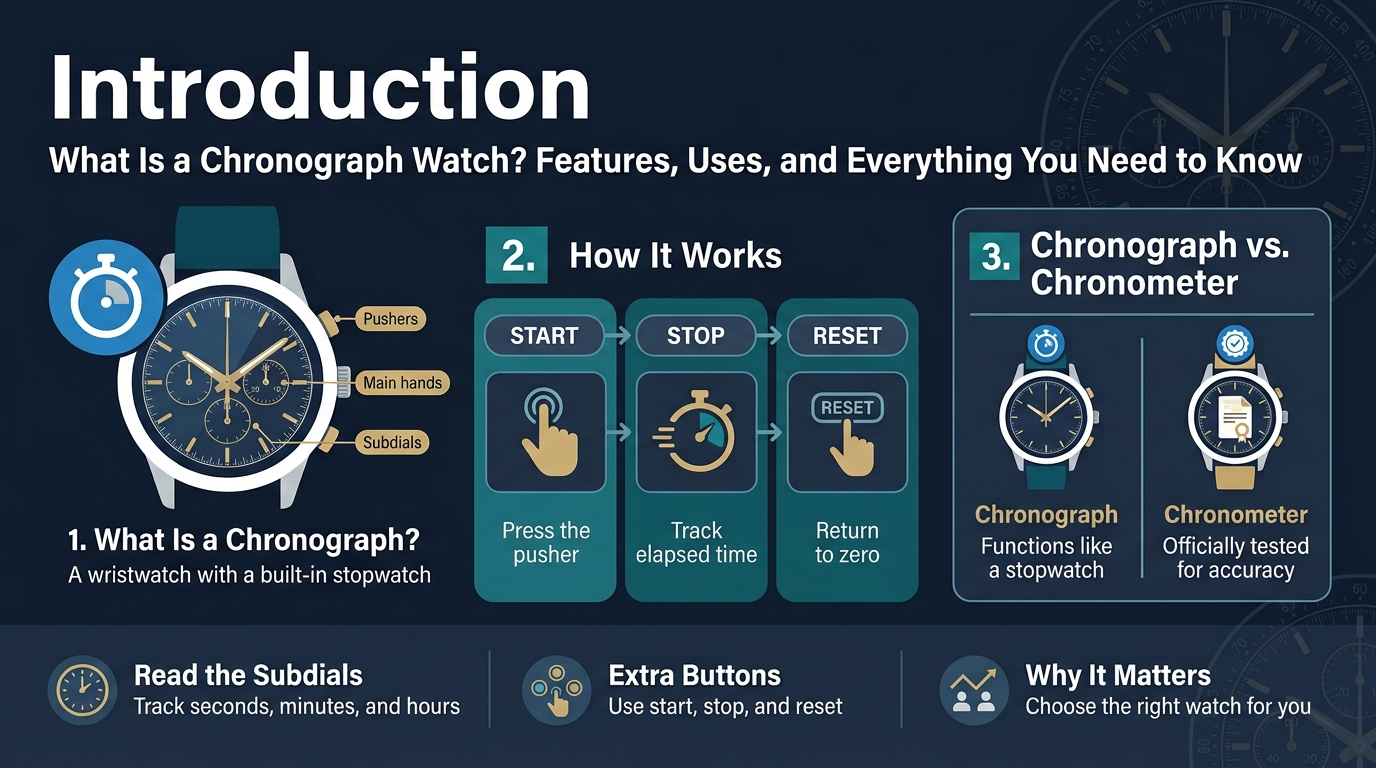
What Is a Chronograph Watch? Features, Uses, and Everything You Need to Know
If you’ve ever looked at a watch with extra buttons on the side and tiny dials within the dial and thought, “what is all that for?” — you’re in the right place.
A chronograph watch is essentially a wristwatch with a built-in stopwatch. That’s the short answer. But there’s a lot more going on beneath the surface, and once you understand it, these watches start to make a lot more sense — and look a lot more interesting.
This guide is for anyone who’s new to chronographs, whether you’re thinking about buying one, just got one as a gift, or simply want to stop nodding along when someone mentions a tachymeter scale.
Here’s what we’ll cover:
- How a chronograph actually works — the pushers, the hands, and what happens when you press start
- How to read the subdials — so you’re not just guessing what each small dial is tracking
- Chronograph vs. chronometer — two words that sound almost identical but mean very different things
By the end, you’ll know exactly what you’re looking at on the dial, how to use it, and whether a chronograph watch is worth buying for you.
What Makes a Chronograph Different from a Standard Watch
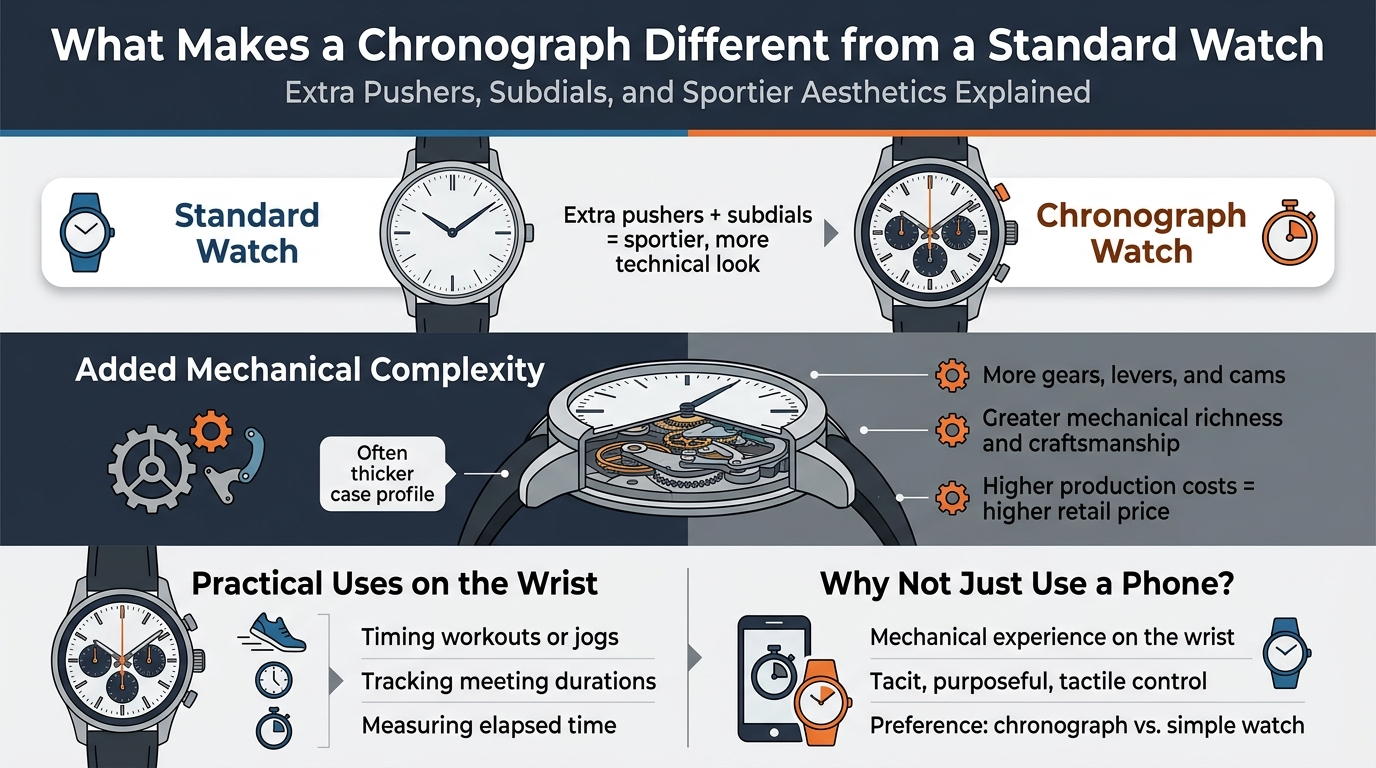
Extra Pushers, Subdials, and Sportier Aesthetics Explained
At a glance, a chronograph watch stands apart through its extra pushers positioned along the case and multiple subdials on the dial face. These elements give chronograph watches a distinctly sportier, more technical appearance compared to standard dress watches.
Added Mechanical Complexity and Why It Raises the Price
Beneath the dial, the differences become even more significant. A chronograph movement incorporates additional gears, levers, and cams that work alongside the standard timekeeping mechanism. This added complication results in:
- Greater mechanical richness and craftsmanship
- Higher production costs, reflected in the retail price
- Often a thicker case profile to accommodate the extra components
This layered engineering is a key reason chronograph watches command a premium over simpler timepieces.
Practical Advantages Over a Simple Phone Stopwatch
With this in mind, you might wonder why not just use your phone. A chronograph watch offers something a phone cannot — a mechanical experience on the wrist. Practical uses include:
- Timing workouts or jogs
- Tracking meeting durations
- Measuring any event requiring elapsed time
The choice ultimately comes down to preference: the tactile, purposeful nature of a chronograph watch feature versus the straightforward simplicity of a standard watch.
How a Chronograph Watch Actually Works
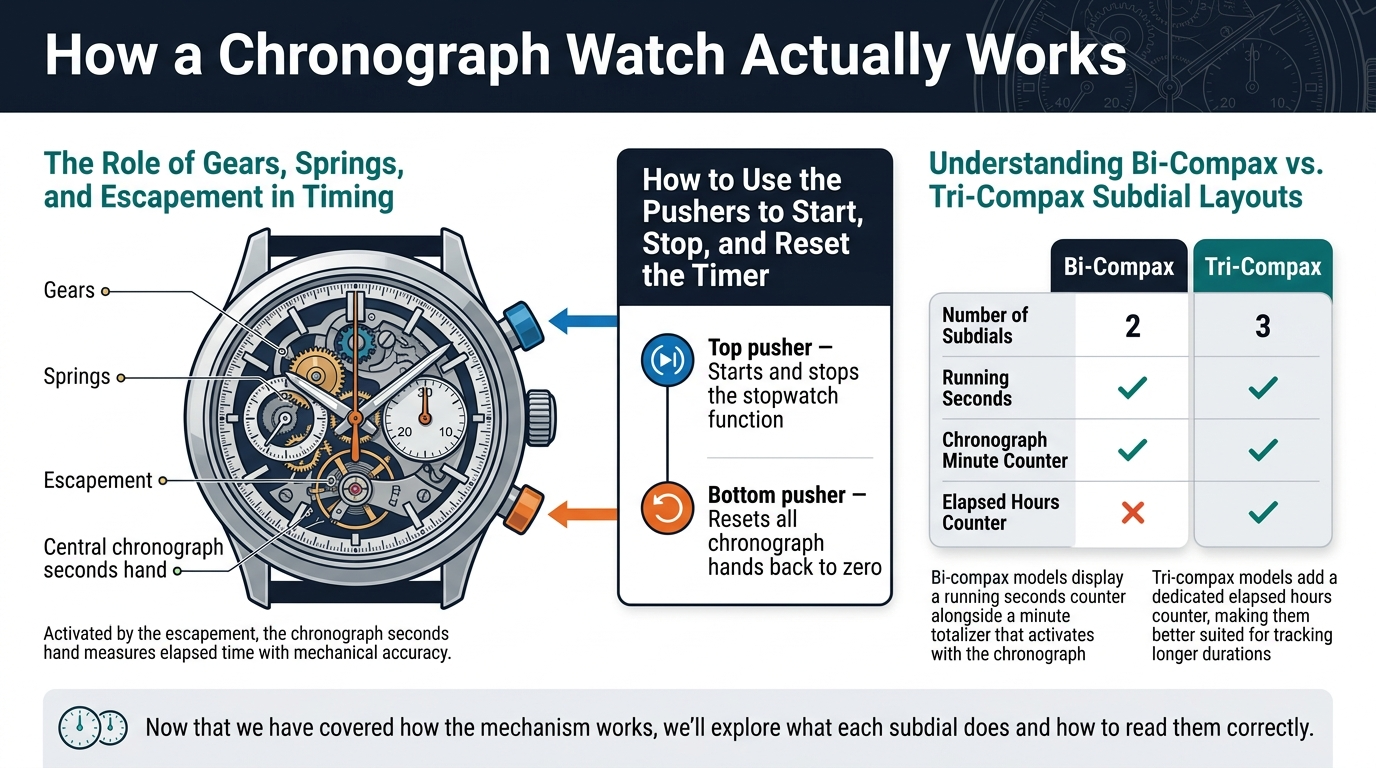
The Role of Gears, Springs, and Escapement in Timing
A chronograph watch operates through a precisely engineered system of gears and springs. When activated, the escapement drives the central chronograph seconds hand, measuring elapsed time with mechanical accuracy.
How to Use the Pushers to Start, Stop, and Reset the Timer
Operating a chronograph is straightforward once you know each pusher’s function:
- Top pusher – Starts and stops the stopwatch function
- Bottom pusher – Resets all chronograph hands back to zero
Understanding Bi-Compax vs. Tri-Compax Subdial Layouts
With this in mind, the subdial layout defines how timing information is displayed. Chronographs typically follow one of two configurations:
| Feature | Bi-Compax | Tri-Compax |
|---|---|---|
| Number of Subdials | 2 | 3 |
| Running Seconds | ✓ | ✓ |
| Chronograph Minute Counter | ✓ | ✓ |
| Elapsed Hours Counter | ✗ | ✓ |
- Bi-compax models display a running seconds counter alongside a minute totalizer that activates with the chronograph
- Tri-compax models add a dedicated elapsed hours counter, making them better suited for tracking longer durations
Now that we have covered how the mechanism works, we’ll explore what each subdial does and how to read them correctly.
What Each Subdial Does and How to Read Them
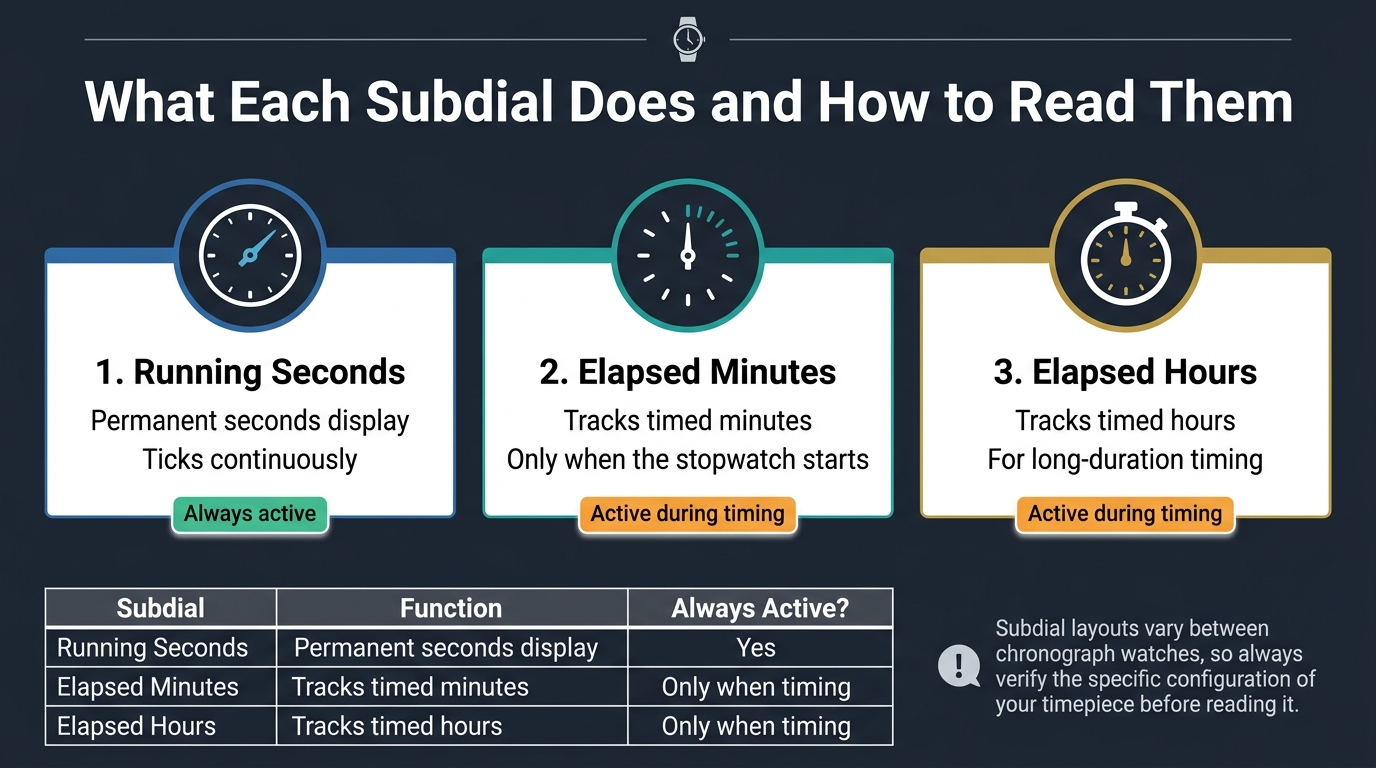
The Running Seconds Subdial and When It Operates
The running seconds subdial functions as the watch’s permanent second hand — it ticks continuously regardless of whether the chronograph function is active. Think of it as the always-on heartbeat of the watch.
The Elapsed Minutes Counter and Its Activation
Unlike the running seconds subdial, the elapsed minutes counter only activates when you start the stopwatch function. It remains stationary until timing begins, then advances incrementally to track how many minutes have passed during a timed event. This makes it essential for understanding how to read chronograph subdials accurately.
The Elapsed Hours Counter for Long-Duration Timing
For extended timing needs, the elapsed hours counter steps in. It records how many full hours have elapsed during a timed session, making it ideal for long-duration events where minute-level tracking isn’t sufficient on its own.
Now that we have covered all three subdials, here’s a quick reference:
| Subdial | Function | Always Active? |
|---|---|---|
| Running Seconds | Permanent seconds display | Yes |
| Elapsed Minutes | Tracks timed minutes | Only when timing |
| Elapsed Hours | Tracks timed hours | Only when timing |
Note: Subdial layouts vary between chronograph watches, so always verify the specific configuration of your timepiece before reading it.
The Four Main Types of Chronograph Watches
A. Standard Chronograph and Its Two-Pusher Operation
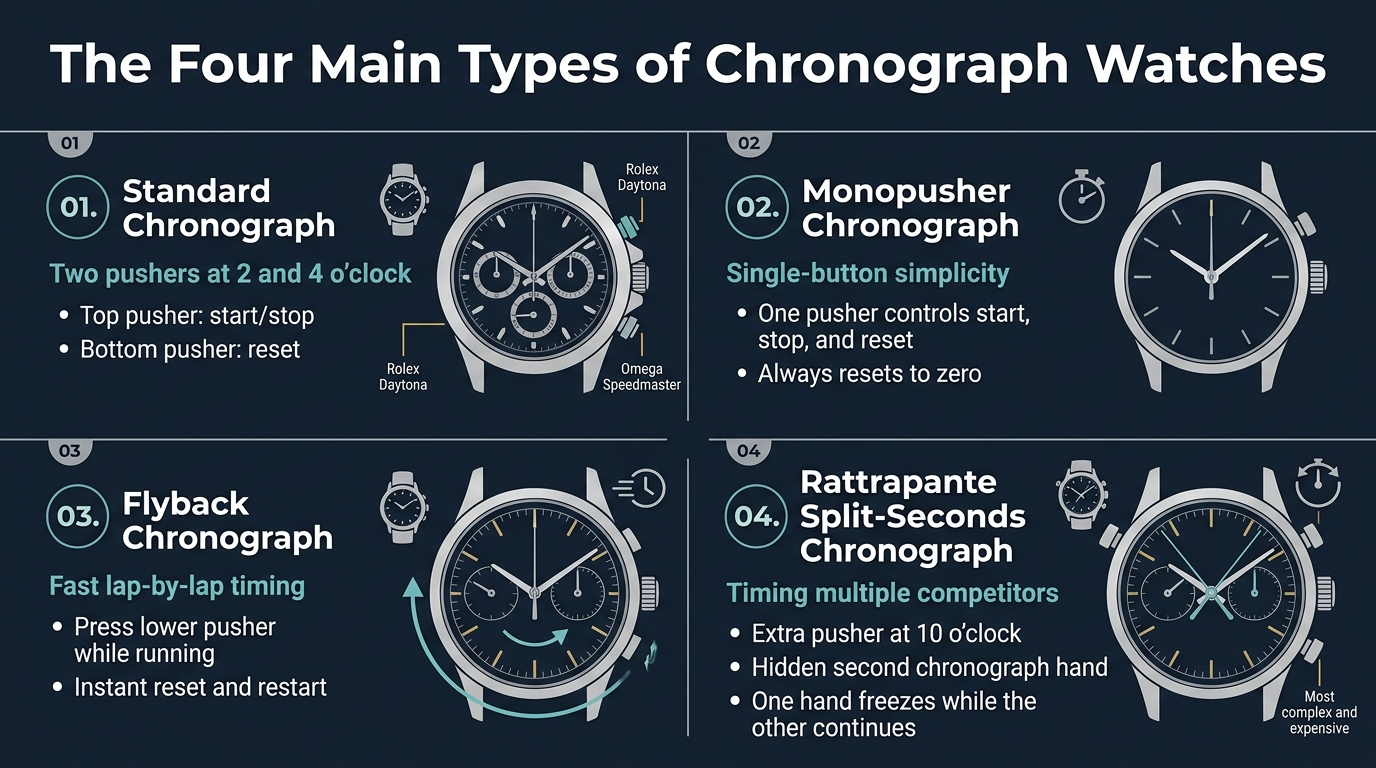
The most common type of chronograph watch features two pushers, typically positioned at 2 and 4 o’clock. The top button starts and stops the timer, while the bottom button resets it. Iconic examples include the Rolex Daytona and Omega Speedmaster.
B. Monopusher Chronograph and Its Single-Button Simplicity
Distinguished by a single pusher — often integrated into the crown — this type controls all start, stop, and reset functions. While it offers a cleaner case design, it cannot resume timing from where it stopped; it always resets to zero.
C. Flyback Chronograph for Fast Lap-by-Lap Timing
Similar to the standard type, the flyback chronograph adds a key advantage: pressing the lower button while the timer is running instantly resets and restarts the hand in one action. This makes it ideal for timing consecutive laps without interruption.
D. Rattrapante Split-Seconds Chronograph for Timing Multiple Competitors
The most complex and expensive of all types of chronograph watches, the rattrapante features an extra pusher (often at 10 o’clock) and a hidden second chronograph hand. Pressing the split-seconds button freezes one hand while the other continues running, allowing simultaneous measurement of two separate events or competitors.
Tachymeter Scale and How It Works with a Chronograph
The Difference Between the Chronograph Function and the Tachymeter Scale
These two features are often confused, but they serve distinct roles:
| Feature | Type | Purpose |
|---|---|---|
| Chronograph | Function | Starts, stops, and resets timing via pushers |
| Tachymeter | Scale | Calculates speed using the chronograph’s elapsed time |
The chronograph is the active mechanism — it measures elapsed time. The tachymeter is a passive scale, typically printed on the bezel or dial edge, that converts that elapsed time into a speed reading. Neither works as effectively without the other.
How to Calculate Speed Over a Known Distance Using Both Tools
Now that we’ve covered what each element does, here’s how they work together in practice:
- Start the chronograph the moment you begin traveling a known distance — commonly 1 kilometer or 1 mile.
- Stop the chronograph the instant you complete that distance.
- Read the seconds hand — its position on the tachymeter scale directly shows your speed.
For example, if 1 km is covered in 30 seconds, the seconds hand lands on 120 on the tachymeter scale, indicating a speed of 120 km/h.
This makes the tachymeter scale explained simply: it removes the mental math entirely.
Chronograph vs. Chronometer: Clearing Up the Confusion
How a Chronometer Is Defined by Precision Certification Standards
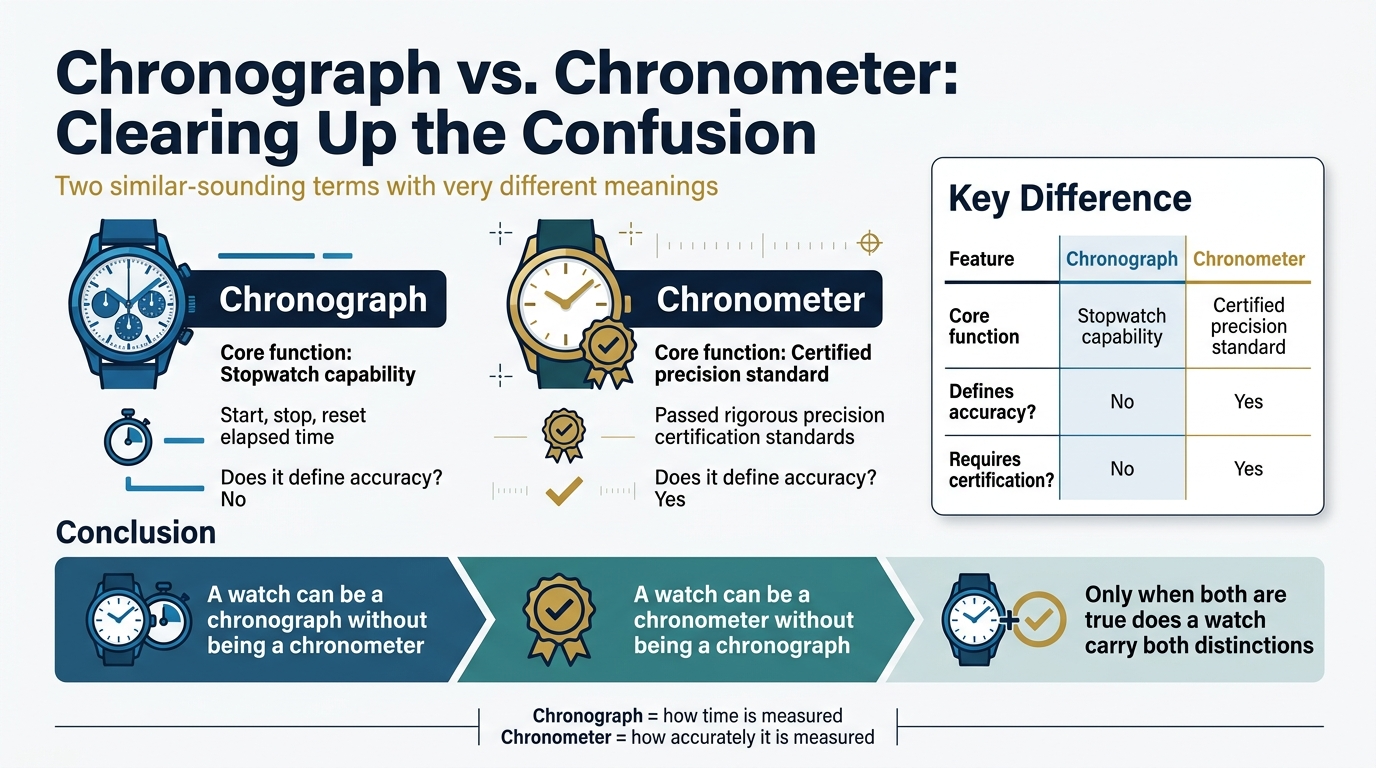
A chronometer is not just a watch that measures time — it is a timepiece that has passed rigorous precision certification standards, confirming its accuracy across a range of conditions. These standards test movement performance against strict tolerance thresholds, ensuring the watch delivers consistent, reliable timekeeping regardless of temperature, position, or environmental shifts.
Why Not All Chronographs Qualify as Chronometers
Now that we have covered what a chronometer actually means, it is easy to see where the confusion with chronograph vs. chronometer begins. Both terms sound similar, but they refer to entirely different attributes:
| Feature | Chronograph | Chronometer |
|---|---|---|
| Core function | Stopwatch capability | Certified precision standard |
| Defines accuracy? | No | Yes |
| Requires certification? | No | Yes |
A chronograph watch is defined by its stopwatch function — the ability to start, stop, and reset elapsed time measurement. A chronometer is defined by how accurately a movement performs under certified testing.
This means a watch can be a chronograph without being a chronometer, and a chronometer without being a chronograph. Only when a chronograph movement also meets the stringent precision certification requirements can it carry both distinctions.
Iconic Chronograph Watches Worth Knowing
A. Rolex Daytona: Motorsport Heritage and Collector Value
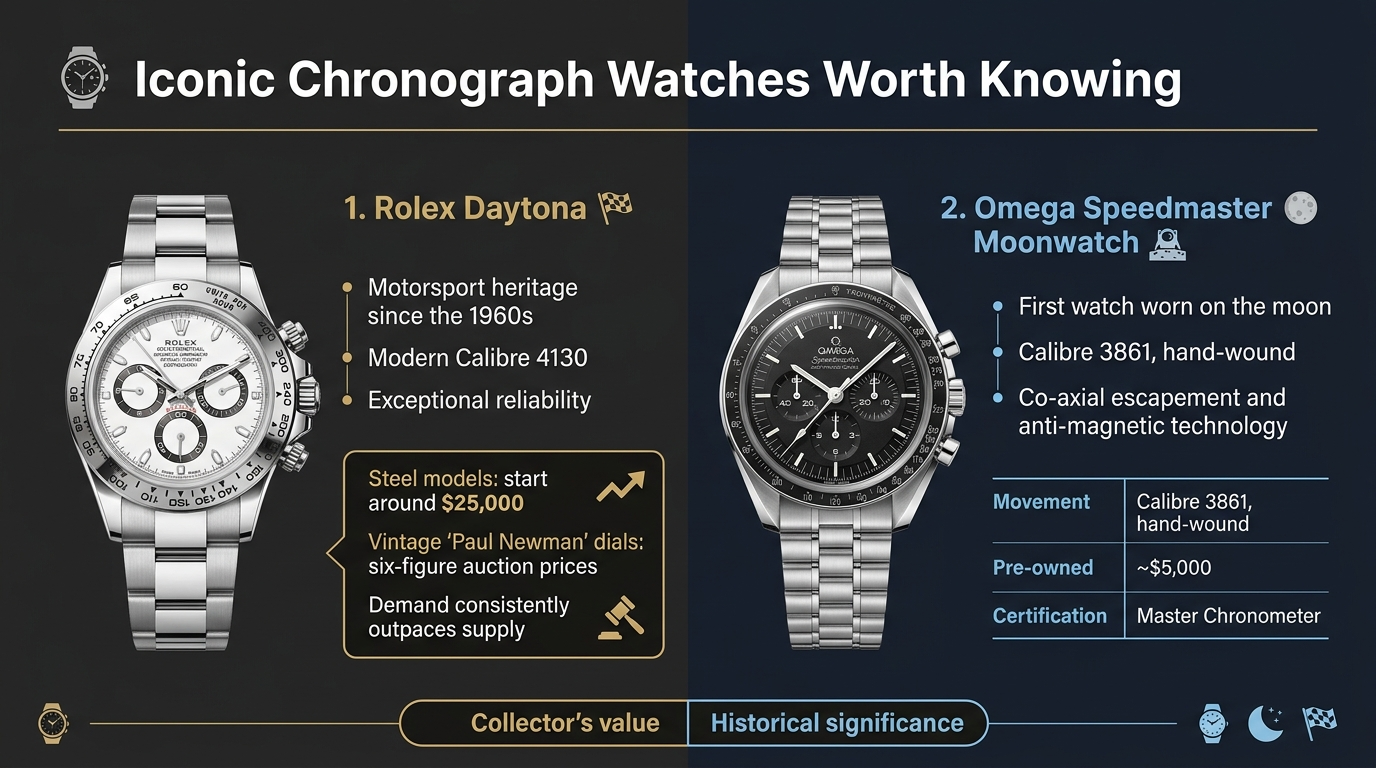
Born in the 1960s for motorsport, the Rolex Daytona represents precision engineering and Rolex’s mastery of chronograph mechanics. Its modern iterations run on the robust Calibre 4130, ensuring exceptional reliability.
From a collector’s standpoint, the Daytona is among the most sought-after chronograph watches in the world:
- Steel models start around $25,000 on the secondary market
- Vintage “Paul Newman” dials command six-figure sums at auction
- Demand consistently outpaces supply, reinforcing its investment appeal
B. Omega Speedmaster Moonwatch: Historical and Technical Appeal
With this in mind, no list of iconic chronograph watches is complete without the Omega Speedmaster Moonwatch — famously certified as the first watch worn on the moon.
Its technical credentials are equally impressive:
- Powered by the hand-wound Calibre 3861, a certified Master Chronometer
- Features a co-axial escapement and advanced anti-magnetic technology
- Design has remained largely unchanged for over 50 years
| Feature | Detail |
|---|---|
| Movement | Calibre 3861, hand-wound |
| Pre-owned price | ~$5,000 |
| Certification | Master Chronometer |
The Speedmaster delivers both historical significance and proven mechanical performance at a comparatively accessible price point.
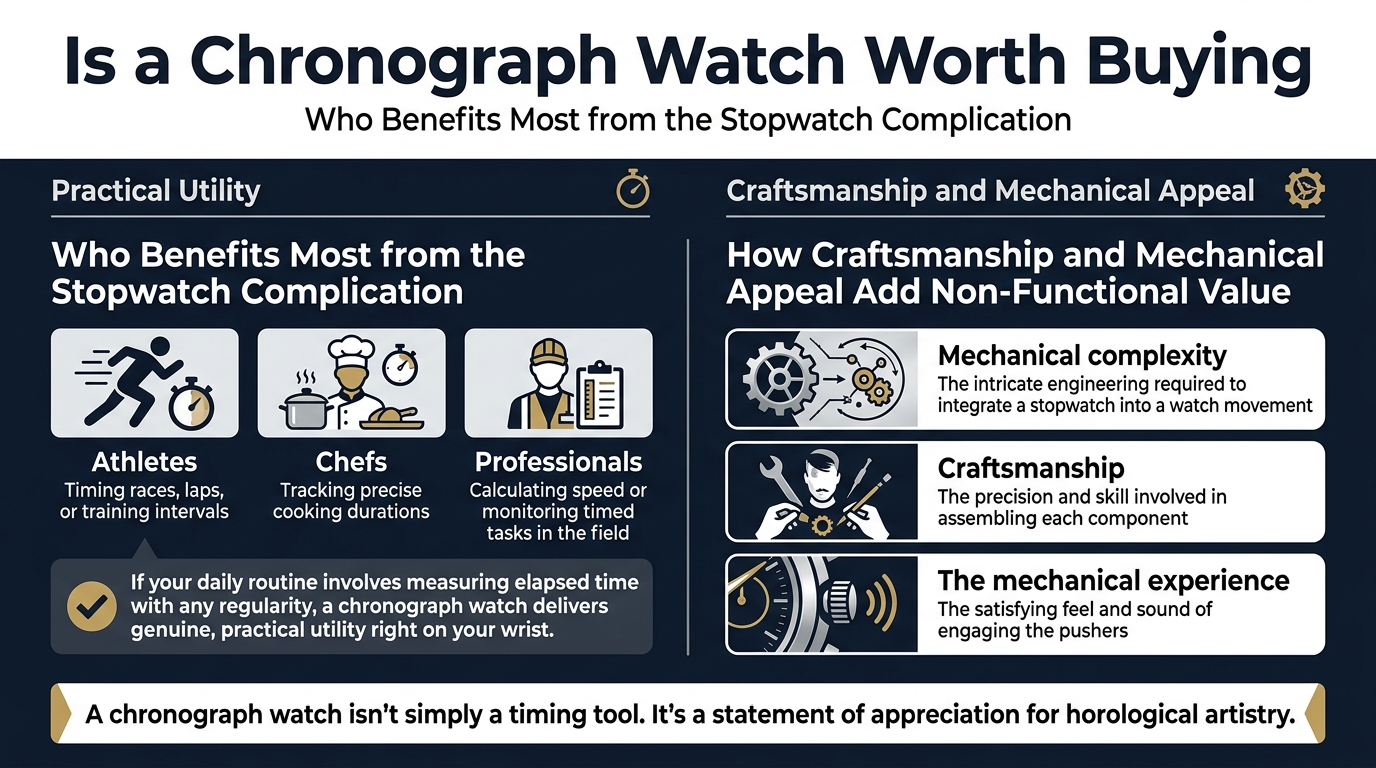
Is a Chronograph Watch Worth Buying
Who Benefits Most from the Stopwatch Complication
Now that we’ve covered the mechanics and history of chronograph watches, it’s worth asking: who actually needs one? The answer depends heavily on lifestyle and profession. Those who benefit most include:
- Athletes timing races, laps, or training intervals
- Chefs tracking precise cooking durations
- Professionals calculating speed or monitoring timed tasks in the field
If your daily routine involves measuring elapsed time with any regularity, a chronograph watch delivers genuine, practical utility right on your wrist.
How Craftsmanship and Mechanical Appeal Add Non-Functional Value
Previously, I’ve outlined what a chronograph does — but its worth extends well beyond function. For many wearers, the value is deeply subjective, rooted in an appreciation for:
- Mechanical complexity — the intricate engineering required to integrate a stopwatch into a watch movement
- Craftsmanship — the precision and skill involved in assembling each component
- The mechanical experience — the satisfying feel and sound of engaging the pushers
With this in mind, a chronograph watch isn’t simply a timing tool. It’s a statement of appreciation for horological artistry, making it worth buying even for those who rarely use the stopwatch function.
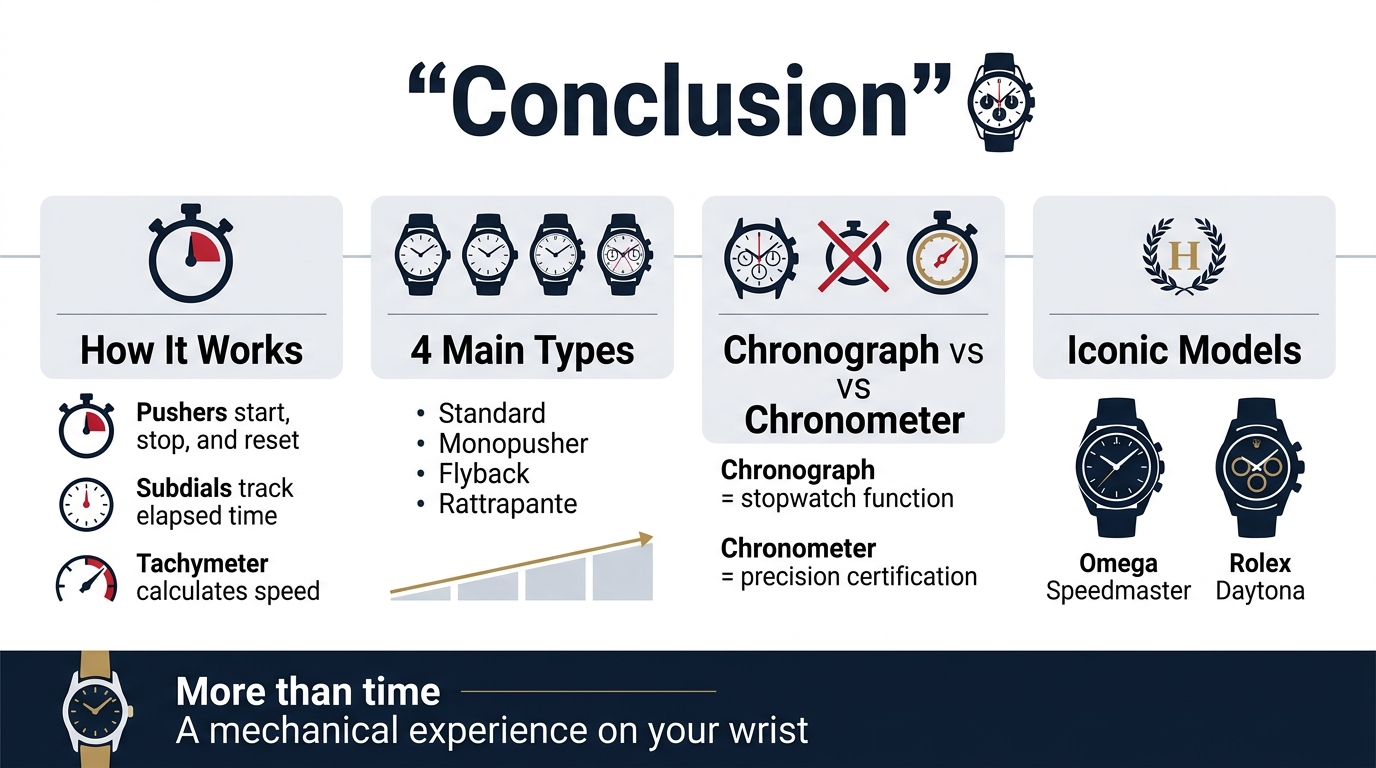
A chronograph is one of the most practical and mechanically satisfying complications you can wear on your wrist. From understanding how the pushers work, to reading the subdials, to using a tachymeter scale to calculate speed, there is a lot going on, but none of it is out of reach once you know what to look for. You have also seen how the four main types, standard, monopusher, flyback, and rattrapante, each serve different needs and sit at different price points. And if you were mixing up chronograph and chronometer, that is a very common confusion, and now you know the difference.
Whether you are drawn to the heritage of the Omega Speedmaster, the collector appeal of the Rolex Daytona, or simply want a watch that does more than tell time, a chronograph brings something extra to the table. It is a mechanical experience on your wrist, and for many people, that alone makes it worth it. If you are thinking about adding one to your collection, now you have everything you need to make an informed choice.
Leave a Reply