

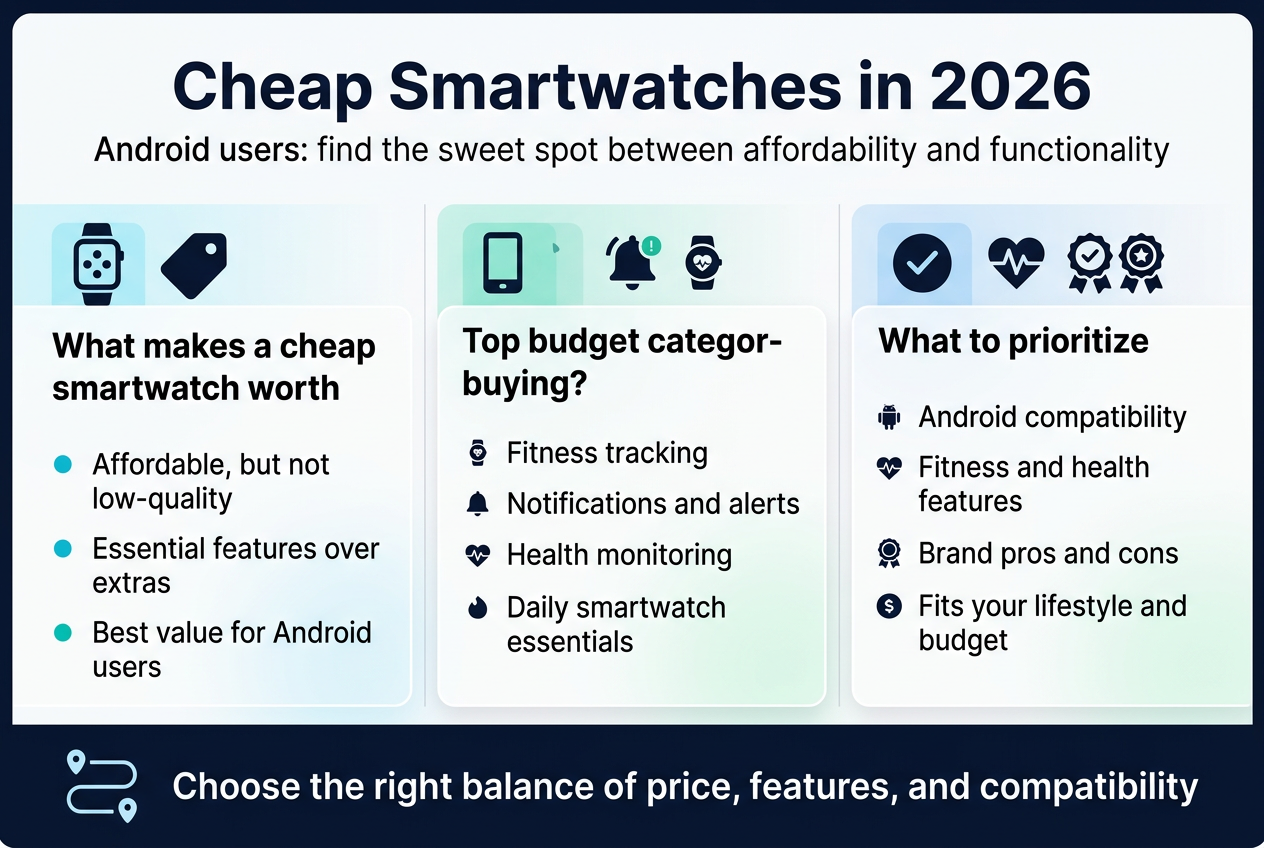
You’re in the market for a smartwatch that won’t drain your bank account, but you’re not sure where to start. Good news: cheap smartwatches don’t have to mean cheap quality. Whether you’re an Android user looking for your first wearable or someone wanting solid features without the premium price tag, this guide breaks down everything you need to know about budget smartwatches that actually deliver.
This comprehensive guide is perfect for budget-conscious shoppers, Android users seeking their first smartwatch, fitness enthusiasts on a tight budget, and anyone wanting reliable wearable technology without overspending. We’ll walk you through what separates a truly valuable affordable smartwatch from the duds cluttering up the market.
You’ll discover the key differences between budget smartwatch categories, from basic fitness trackers to full-featured Wear OS devices. We’ll also dive deep into the essential features you should prioritize when shopping for cheap smartwatch features, including battery life, health tracking accuracy, and smartphone compatibility. Finally, we’ll help you match the right budget fitness tracker or smartwatch to your specific lifestyle and needs, so you can make a confident purchase decision that you’ll be happy with for years to come.
Understanding What Makes a Smartwatch “Cheap” Yet Valuable
Defining Budget Smartwatch Price Points Under $200
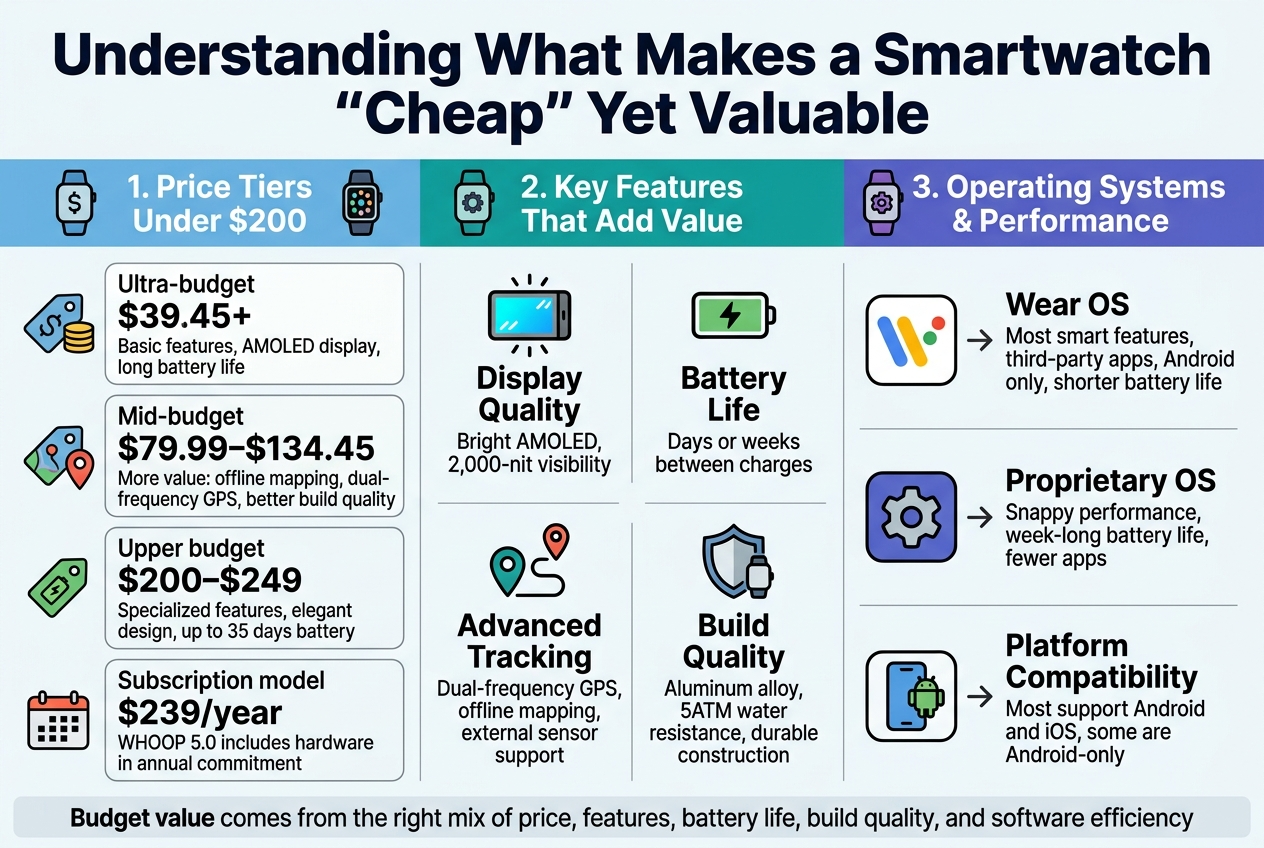
When you’re searching for cheap smartwatches, understanding the price tiers helps you set realistic expectations for features and performance. Budget smartwatches typically fall into distinct categories based on their pricing structure.
The ultra-budget tier starts as low as $39.45 with devices like the Redmi Watch 5, offering basic functionality with AMOLED displays and extended battery life. These entry-level options provide essential smartwatch features without breaking your budget, though you’ll encounter limitations in fitness tracking accuracy and smart features.
Mid-budget options range from $79.99 to $134.45, where you’ll find devices like the Amazfit Active 2 and Huawei Watch Fit 4. These smartwatches deliver significantly more value, incorporating features like offline mapping, dual-frequency GPS, and improved build quality that typically cost hundreds more in premium devices.
The upper budget range extends from $200 to $249, featuring devices like the Hume Band and Withings ScanWatch Light. At this price point, you’re investing in specialized functionality – whether that’s longevity-focused insights or elegant analog designs with extensive battery life up to 35 days.
Subscription-based models like WHOOP 5.0 require a $239 annual commitment but include the hardware, representing a different value proposition that might work better for your long-term budget planning.
Key Features That Distinguish Quality Budget Options
Quality budget smartwatches stand out through specific features that deliver exceptional value for your investment. Understanding these distinguishing characteristics helps you identify which affordable options won’t leave you disappointed.
Display technology serves as a primary differentiator in budget smartwatches. Quality options feature bright AMOLED displays with impressive visibility, like the Huawei Watch Fit 4’s 2,000-nit brightness or the CMF Watch 3 Pro’s refined UI design. These displays provide premium-feeling experiences that rival expensive alternatives, while cheaper models often compromise with dim or pixelated screens.
Battery life represents another crucial distinction. Premium budget options deliver exceptional longevity – the Withings ScanWatch Light offers up to 35 days, while the WHOOP 5.0 provides over 14 days of continuous use. This extended battery performance means you spend more time using your device rather than constantly charging it.
Advanced tracking capabilities set quality budget smartwatches apart from basic fitness bands. Features like dual-frequency GPS, offline mapping, and external sensor support – found in devices like the Amazfit Active 2 and Huawei Watch Fit 4 – were previously exclusive to expensive watches. These capabilities ensure accurate fitness tracking without requiring premium pricing.
Build quality distinguishes lasting investments from temporary solutions. Quality budget options incorporate aluminum alloy frames, water resistance ratings like 5ATM, and durable construction that withstands daily wear while maintaining their appearance over time.
Operating System Choices and Their Impact on Performance
Your choice of operating system significantly impacts your smartwatch’s performance, compatibility, and available features. Budget smartwatches typically run on three main platforms, each offering distinct advantages and limitations.
Wear OS provides the most comprehensive smart features but demands higher prices. The Xiaomi Watch 2 represents the most affordable Wear OS option, offering Google’s full ecosystem with third-party app support. However, this advanced functionality comes with trade-offs – you’ll experience single-day battery life and Android-only compatibility, limiting your device choices.
Proprietary operating systems dominate the budget smartwatch market, offering optimized performance and extended battery life. Devices like the Huawei Watch Fit 4 and CMF Watch 3 Pro run custom software that delivers snappy performance and week-long battery life. These systems sacrifice extensive app ecosystems for reliability and efficiency, providing essential smartwatch functions without overwhelming complexity.
Platform compatibility varies significantly across operating systems. Most budget smartwatches support both Android and iOS through dedicated companion apps, though functionality may differ between platforms. The Xiaomi Watch 2 exclusively supports Android devices, while others like the Withings ScanWatch Light and Hume Band offer cross-platform compatibility.
Performance optimization in budget operating systems focuses on core functionality rather than extensive customization. This approach ensures smooth operation even on budget hardware, preventing the sluggish performance that can plague cheaper devices trying to run resource-intensive software.
Top Budget Smartwatch Categories for Every Android User
Best Overall Value Smartwatches with Premium Features
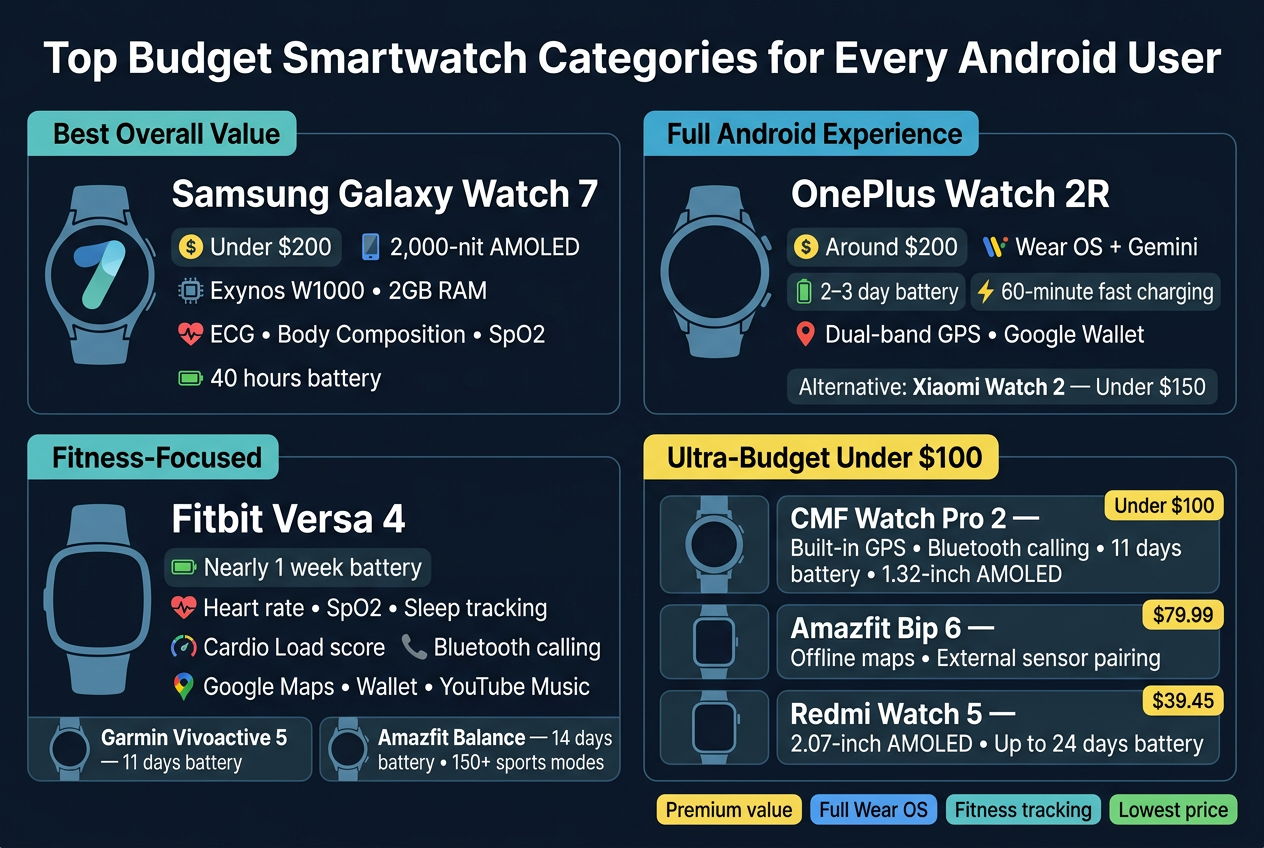
When you’re looking for the perfect balance between affordability and high-end features, the Samsung Galaxy Watch 7 stands out as your best option. You can find this premium smartwatch for under $200 during frequent sales, making it an exceptional value proposition. You’ll get flagship-quality performance with the blazing-fast Exynos W1000 chip and 2GB of RAM, delivering responsiveness that outshines any other budget pick.
Your display experience will be outstanding with the 2,000-nit AMOLED screen available in both 1.3-inch and 1.5-inch sizes. You’ll appreciate the sapphire crystal glass protection and MIL-STD-810H durability rating that ensures your investment lasts. The comprehensive health sensors include heart rate monitoring, ECG, body composition analysis, SpO2, and skin temperature readings – features typically reserved for much more expensive watches.
You’ll have access to the full Google Play Store ecosystem and Gemini AI assistance, allowing you to communicate directly with your favorite apps for calendar checks and email summaries. With up to 40 hours of battery life and years of Wear OS updates ahead, you’re getting premium smartwatch capabilities at a fraction of the original cost.
Wear OS Watches That Deliver Full Android Experience
For a complete Android smartwatch experience without breaking the bank, the OnePlus Watch 2R delivers impressive value at around $200. You’ll enjoy proper Wear OS functionality with access to thousands of apps, Gemini integration, and the responsive performance you’d expect from a flagship device.
Your battery life will be remarkably better than typical Wear OS watches, lasting 2-3 days on a single charge with lightning-fast 60-minute charging from 0%. The 1.43-inch AMOLED display provides excellent visibility, though you’ll only have one size option available.
You’ll get dual-band GPS for accurate tracking and Google Wallet support for contactless payments. While you won’t find advanced health sensors like ECG or skin temperature, the basic heart rate and SpO2 monitoring handles everyday fitness needs adequately.
If you’re seeking an alternative, the Xiaomi Watch 2 offers the most affordable entry into Wear OS at under $150. You’ll sacrifice some build quality and battery life compared to the OnePlus option, but you’ll still access the full Google ecosystem with surprisingly solid performance for casual smartwatch users.
Fitness-Focused Watches for Health and Exercise Tracking
Your best fitness-focused budget option is the Fitbit Versa 4, delivering comprehensive health insights in a lightweight, comfortable design. You’ll enjoy nearly a week of battery life with accurate heart rate and SpO2 monitoring that can detect AFib warning signs and assess sleep quality through HRV analysis.
You’ll benefit from Google’s continuous software improvements, including the new Fitbit Cardio Load score that evaluates workout difficulty and recovery recommendations. The built-in mic and speaker enable Bluetooth calling, while Google Maps, Google Wallet, and YouTube Music provide essential smart features.
For more specialized fitness tracking, consider the Garmin Vivoactive 5. You’ll receive 11 days of battery life with Garmin’s renowned fitness insights, including Body Battery estimates, Sleep Coaching guidance, and personalized workout recovery suggestions. Your health monitoring will include comprehensive tracking of Intensity Minutes and workout benefit analysis to prevent overtraining.
The Amazfit Balance offers an excellent middle ground with 150+ sports modes, AI coaching, and 14-day battery life. You’ll get offline voice assistance, Zepp Flow AI powered by ChatGPT-4o for hands-free messaging, and daily readiness scores to optimize your training schedule.
Ultra-Budget Options Under $100 That Still Perform
When your budget is extremely tight, the CMF Watch Pro 2 delivers surprising functionality for under $100. You’ll get built-in GPS, heart rate and SpO2 tracking, plus Bluetooth calling capabilities – features rarely found at this price point.
Your display experience includes a high-resolution 1.32-inch AMOLED screen with 353ppi pixel density and 60Hz refresh rate that rivals more expensive options. You’ll enjoy 11 days of battery life with the convenience of a rotating crown for easy navigation and interchangeable bezels for style customization.
For even more savings, the Amazfit Bip 6 provides exceptional value at just $79.99. You’ll benefit from offline maps – virtually unheard of in sub-$100 smartwatches – plus external sensor pairing capabilities for improved heart rate accuracy during workouts.
The Redmi Watch 5 offers the most affordable option at $39.45, featuring a stunning 2.07-inch AMOLED display with up to 24 days of battery life. While you’ll sacrifice fitness tracking accuracy, you’ll get excellent value for basic smartwatch functions, notifications, and everyday wear.
Essential Features to Look for in Affordable Smartwatches
Health Monitoring Capabilities and Sensor Accuracy
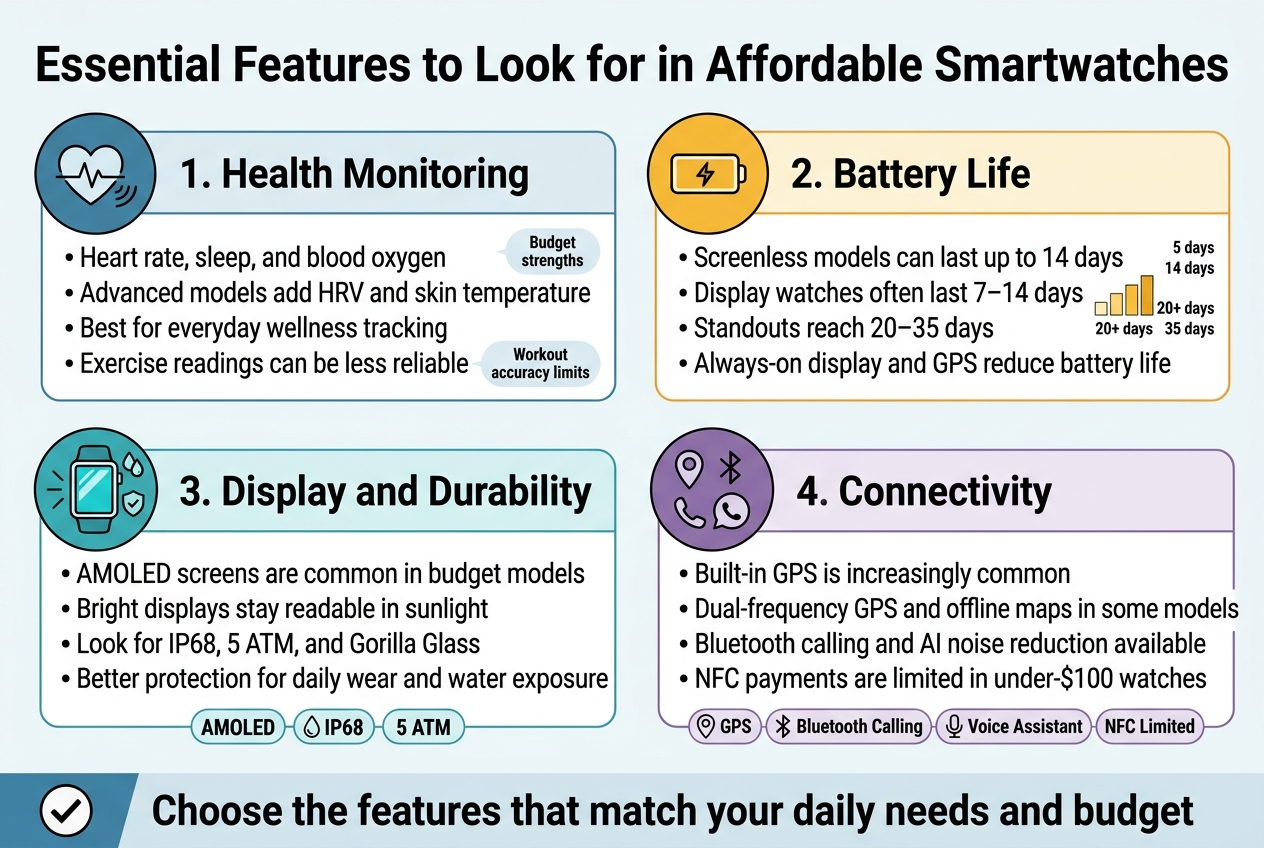
When you’re evaluating cheap smartwatches, health monitoring capabilities form the foundation of your device’s value proposition. You’ll find that even budget-friendly options like the Amazfit Bip 6 and WHOOP 5.0 deliver impressive sensor accuracy for essential health metrics. Most affordable smartwatches provide heart rate monitoring, sleep stage tracking, and blood oxygen level measurements, with some models like the Hume Band offering advanced metrics such as heart rate variability and skin temperature monitoring.
Your expectations should align with the price point – while budget smartwatches excel at basic health tracking, you might encounter inconsistencies during high-intensity workouts. The Redmi Watch 5 and Amazfit Active 2 demonstrate this limitation, where heart rate readings during exercise can prove unreliable compared to premium alternatives. However, models like the CMF Watch Pro 2 and Pro 3 incorporate 24/7 health monitoring with stress tracking and breathing quality assessments, delivering solid performance for everyday wellness tracking.
Battery Life Expectations and Charging Requirements
Your battery life expectations can vary dramatically across budget smartwatch categories. Screenless devices like the WHOOP 5.0 excel in this area, offering up to 14 days of continuous use, while the Hume Band provides approximately 5 days of battery life. For watches with displays, you’ll typically see 7-14 days of usage, with standout performers like the Withings ScanWatch Light delivering up to 35 days on a single charge.
The Amazfit Bip 6 exemplifies excellent battery management, providing up to 20 days of real-world usage, while the BANLVS Military watch extends this to an impressive 25-30 days. However, you should note that always-on display features and GPS usage significantly impact battery performance. The CMF Watch 3 Pro demonstrates this balance, offering 13 days with normal use but reducing to 9 days under heavy usage conditions.
Display Quality and Durability Standards
Your display experience on cheap smartwatches has improved significantly, with many budget options now featuring vibrant AMOLED screens. The Huawei Watch Fit 4 showcases this advancement with its bright 1.82-inch AMOLED display reaching 2,000 nits, making it easily readable in direct sunlight. Similarly, the Amazfit Active 2’s 1.32-inch AMOLED display delivers sharp visuals that rival more expensive alternatives.
You’ll encounter various durability standards across budget models. The CMF Watch Pro 2 and Pro 3 offer IP68 water resistance, suitable for daily wear and light water exposure, while models like the BANLVS Military provide 5 ATM water resistance for swimming activities. The Amazfit Bip 6 incorporates Gorilla Glass protection, enhancing screen durability against scratches and impacts that you might encounter during daily activities.
Connectivity Options Including GPS, NFC, and Bluetooth Calling
Your connectivity requirements will determine which budget smartwatch best suits your needs. Built-in GPS has become increasingly common in affordable options, with the Huawei Watch Fit 4 offering dual-frequency GPS and offline mapping capabilities – features typically reserved for premium devices. The Amazfit Active 2 and CMF Watch Pro 3 also provide reliable GPS tracking for outdoor activities without requiring your phone.
Bluetooth calling functionality appears in several budget models, with the CMF Watch Pro series incorporating AI noise reduction for crystal-clear conversations. You’ll find that models like the AEAC IDW28 and Quican IDW19 support voice assistants, with some featuring Alexa integration for smart home control. However, NFC payment support remains limited in the under-$100 category, with most budget smartwatches focusing on essential connectivity features rather than advanced payment capabilities.
Platform Compatibility and Smart Features
Android Integration and App Support Differences
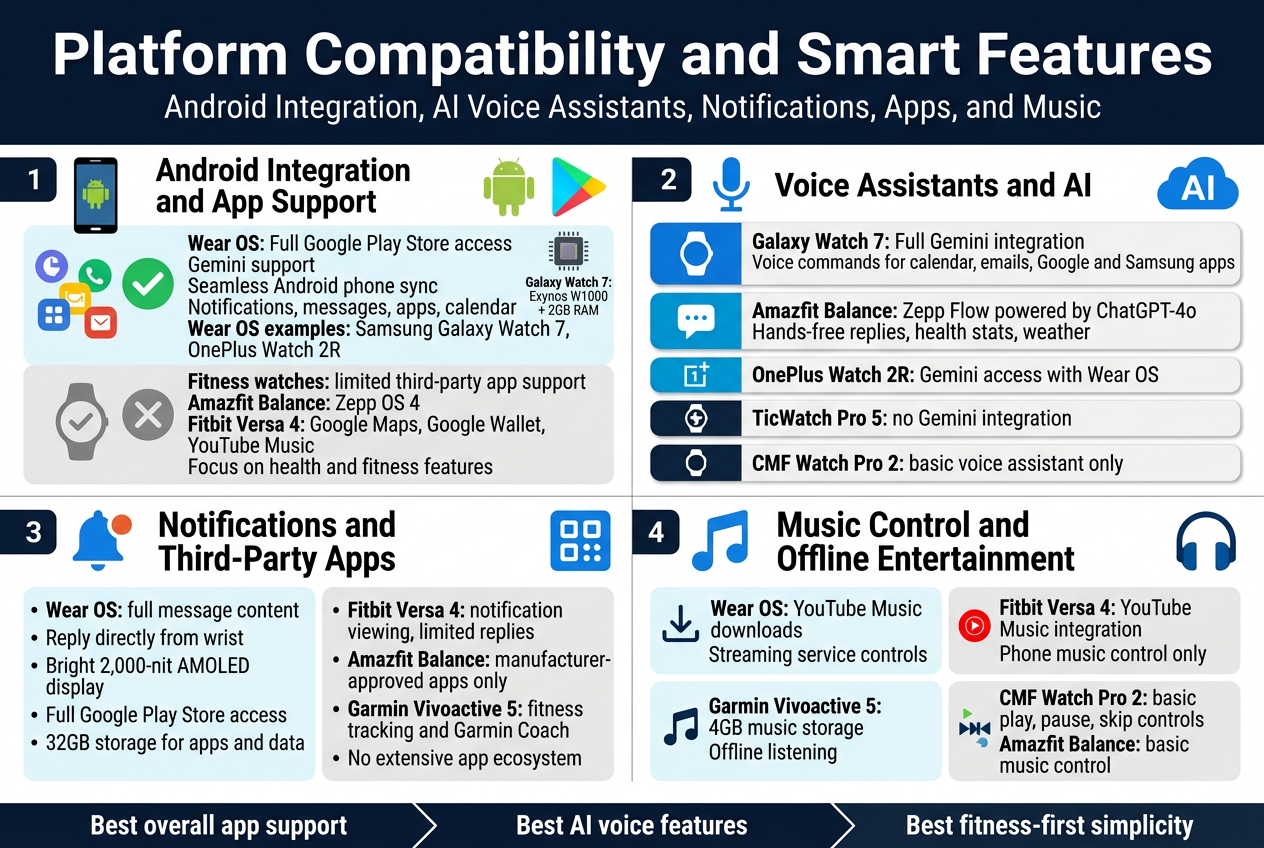
When you’re choosing a cheap smartwatch, you’ll encounter significant differences in Android integration depending on the operating system. Wear OS watches like the Samsung Galaxy Watch 7 and OnePlus Watch 2R provide the most comprehensive Android experience, giving you full access to the Google Play Store, Gemini support, and seamless integration with your Android phone’s ecosystem.
Your Wear OS options will sync notifications, messages, and apps directly from your phone, allowing you to respond to texts, check emails, and manage your calendar directly from your wrist. The Galaxy Watch 7, for instance, uses its powerful Exynos W1000 chip and 2GB of RAM to deliver flagship-quality performance that rivals more expensive alternatives.
In contrast, fitness-focused watches like the Amazfit Balance and Fitbit Versa 4 offer limited third-party app support. While you’ll get essential Google services like Google Maps, Google Wallet, and YouTube Music on the Versa 4, you won’t have the extensive app library that Wear OS provides. The Amazfit Balance runs on Zepp OS 4, which focuses more on health and fitness features rather than comprehensive app integration.
Voice Assistants and AI-Powered Capabilities
Your voice assistant options vary dramatically across different price points and platforms. Premium budget options like the Galaxy Watch 7 offer full Gemini integration, allowing you to communicate directly with Google and Samsung apps, check your calendar, or summarize emails using voice commands.
The Amazfit Balance brings innovative AI capabilities through Zepp Flow, powered by ChatGPT-4o, which lets you reply to messages hands-free, ask about your health statistics, and check weather conditions. This offline voice assistant continues to improve over time, though it can occasionally be glitchy during heavy use.
Mid-range options like the OnePlus Watch 2R provide Gemini access as part of their Wear OS implementation, giving you sophisticated voice command capabilities that budget fitness watches simply can’t match. However, some alternatives like the TicWatch Pro 5 haven’t managed to integrate Gemini, limiting your voice assistant experience.
Budget options like the CMF Watch Pro 2 include basic voice assistants for simple commands, but don’t expect the advanced AI capabilities found in more expensive alternatives.
Notification Handling and Third-Party App Access
Your notification experience depends heavily on your chosen platform. Wear OS watches excel at notification management, displaying full message content and allowing you to respond directly from your wrist. The Galaxy Watch 7’s bright 2,000-nit AMOLED display ensures you can read notifications clearly in any lighting condition.
Fitness watches offer more basic notification handling. The Fitbit Versa 4’s large AMOLED display shows notification content effectively, but your response options are limited compared to Wear OS alternatives. You’ll see incoming calls, texts, and app notifications, but comprehensive interaction requires reaching for your phone.
Third-party app access varies significantly. Wear OS watches provide full Google Play Store access, meaning you can download fitness apps, productivity tools, and entertainment options directly to your watch. The OnePlus Watch 2R and Galaxy Watch 7 both offer 32GB of storage for apps and data.
Budget fitness watches typically limit you to manufacturer-approved apps. The Amazfit Balance offers 150+ sports modes and meditation tools but doesn’t support third-party app installation. Similarly, the Garmin Vivoactive 5 provides essential fitness tracking and Garmin Coach functionality but lacks extensive app ecosystem access.
Music Control and Offline Entertainment Options
Your music and entertainment options depend on both your budget and platform choice. Wear OS watches offer the most comprehensive entertainment features, with the Galaxy Watch 7 supporting YouTube Music downloads and playbook controls for various streaming services.
The Fitbit Versa 4 includes YouTube Music integration and provides music control capabilities, though it lacks the music playback controls found in its predecessor, the Versa 3. You can control your phone’s music playback but cannot store music directly on the watch.
Budget fitness watches like the CMF Watch Pro 2 offer basic music controls for your connected phone, allowing you to play, pause, and skip tracks without additional storage or streaming capabilities. The Garmin Vivoactive 5 provides 4GB of music storage, enabling you to download songs for offline listening during workouts.
Mid-range options like the Amazfit Balance focus more on fitness features than entertainment, though they do provide basic music control functionality. Your entertainment experience will be more limited compared to full Wear OS implementations, but sufficient for basic workout music management.
Fitness and Health Tracking Capabilities
Heart Rate Monitoring and Advanced Health Sensors
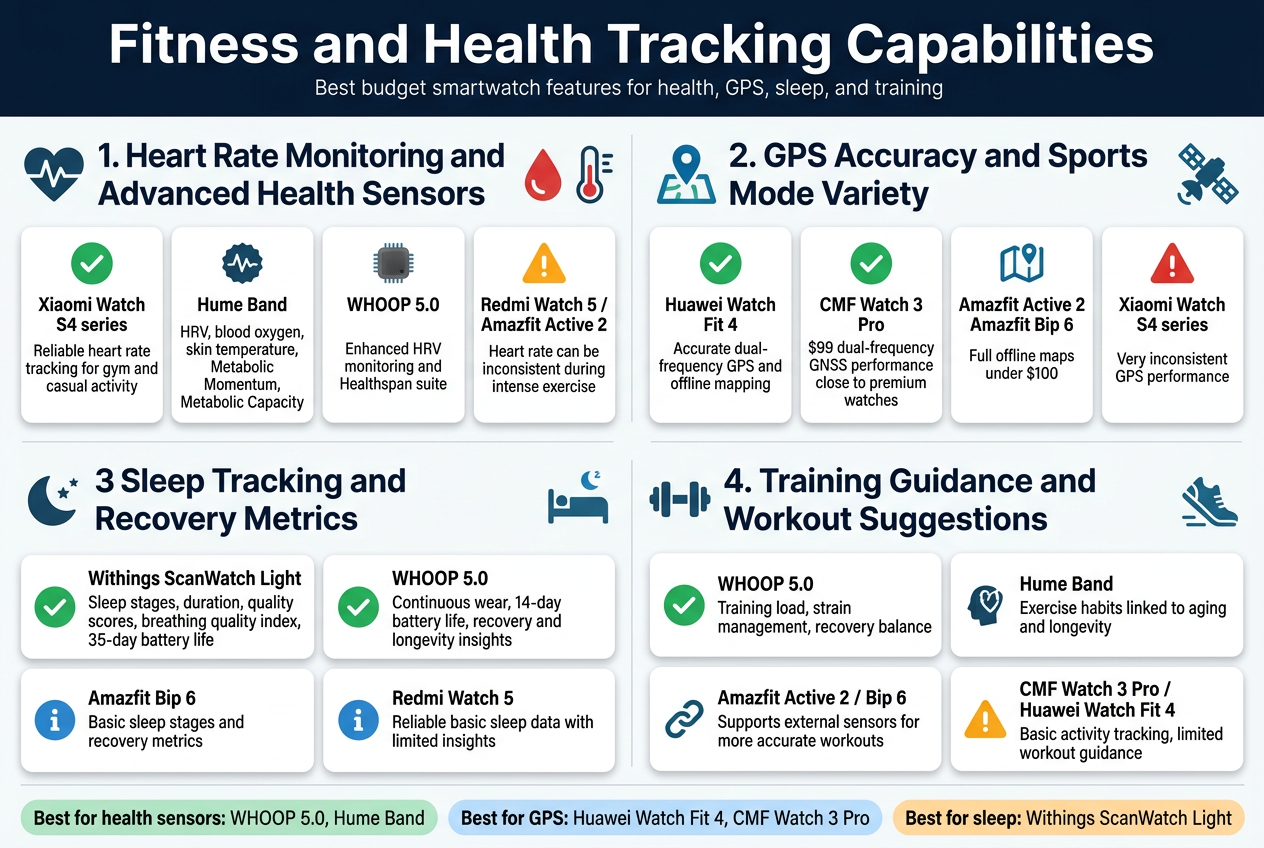
When you’re shopping for a cheap smartwatch, you’ll find that heart rate monitoring has become a standard feature across most budget devices. However, the accuracy can vary significantly between models. The Xiaomi Watch S4 series demonstrates surprisingly reliable heart rate tracking during gym sessions and casual activities, making it a solid choice for your basic fitness needs.
If you’re serious about comprehensive health monitoring, consider devices like the Hume Band, which offers advanced sensors for tracking heart rate variability, blood oxygen levels, and skin temperature. While priced at $249, it provides unique metrics like Metabolic Momentum and Metabolic Capacity that give you insights into your aging process – features typically reserved for premium devices.
The WHOOP 5.0 stands out with significantly enhanced sensor technology packed into an even smaller body than its predecessor. Your tracking experience will benefit from improved heart rate variability monitoring and the new Healthspan suite that focuses on longevity-focused metrics.
However, you should be aware that cheaper options like the Redmi Watch 5 and Amazfit Active 2 still struggle with heart rate accuracy during intense exercise. For these devices, the readings can be inconsistent during interval running sessions or gym workouts, though they perform adequately for casual fitness tracking.
GPS Accuracy and Sports Mode Variety
Your GPS tracking needs will determine which budget smartwatch offers the best value. The Huawei Watch Fit 4 excels in this area, featuring accurate dual-frequency GPS and offline mapping capabilities – features you’d typically find in watches costing hundreds more. This makes it an exceptional choice if you’re a runner or cyclist who needs precise location tracking.
The CMF Watch 3 Pro, despite its $99 price point, surprised testers with dual-frequency GNSS tracking that performed on par with watches three times the price. During testing sessions, you’ll find the GPS accuracy comparable to much more expensive alternatives, making it an outstanding budget option for outdoor activities.
For offline mapping capabilities, both the Amazfit Active 2 and Amazfit Bip 6 offer full mapping functionality at under $100 – a feature virtually unheard of in this price range. The Bip 6’s upgrade from TFT to AMOLED display makes the mapping experience much more enjoyable during your outdoor adventures.
However, you should be cautious with devices like the Xiaomi Watch S4 series, which suffers from very inconsistent GPS performance. While it excels in design and heart rate monitoring, the unreliable location tracking makes it unsuitable for serious runners or cyclists who depend on accurate distance and route measurements.
Sleep Tracking and Recovery Metrics
Your sleep monitoring experience with budget smartwatches has improved dramatically. The Withings ScanWatch Light offers impressive sleep tracking features including stages, duration, quality scores, and breathing quality index – matching the capabilities of more expensive models in the Withings lineup. With up to 35 days of battery life, you can wear it continuously without worrying about charging interruptions.
The WHOOP 5.0 remains unmatched for understanding the balance between your training load and recovery. Its screenless design and 14-day battery life make it ideal for continuous wear, giving you comprehensive recovery insights that help optimize your training schedule. The new Healthspan suite adds longevity-focused sleep metrics that compete with newer specialized devices.
For basic sleep tracking needs, the Amazfit Bip 6 provides decent sleep monitoring capabilities through the robust Zepp Health app. While the analysis might not be as detailed as premium options, you’ll get essential sleep stage information and basic recovery metrics.
The Redmi Watch 5 offers solid sleep tracking accuracy despite limited insights. While you won’t get advanced recovery recommendations, the basic sleep data proves reliable for monitoring your sleep patterns over time.
Training Guidance and Workout Suggestions
Your workout experience will vary significantly depending on which budget smartwatch you choose. The WHOOP 5.0 excels in providing insights for managing your training load, making it ideal if you’re an athlete who cares about balancing workout intensity with recovery periods. The strain management features help you understand when to push harder and when to prioritize rest.
The Hume Band takes a unique approach by focusing on longevity practices rather than traditional workout metrics. Through the companion app, you can see how your exercise habits influence your aging process, providing a different perspective on fitness that goes beyond immediate performance metrics.
For those seeking external sensor support, both the Amazfit Active 2 and Bip 6 allow you to pair additional sensors for more accurate tracking during workouts. This feature helps compensate for the sometimes inconsistent onboard heart rate monitoring during intense exercise sessions.
However, you should note that most budget smartwatches offer limited smart features and workout guidance compared to premium alternatives. Devices like the CMF Watch 3 Pro and Huawei Watch Fit 4 provide basic activity tracking but lack comprehensive training programs or detailed workout suggestions that you might find in higher-end fitness wearables.
Brand-Specific Advantages and Limitations
Samsung Galaxy Watches for Comprehensive Smart Features
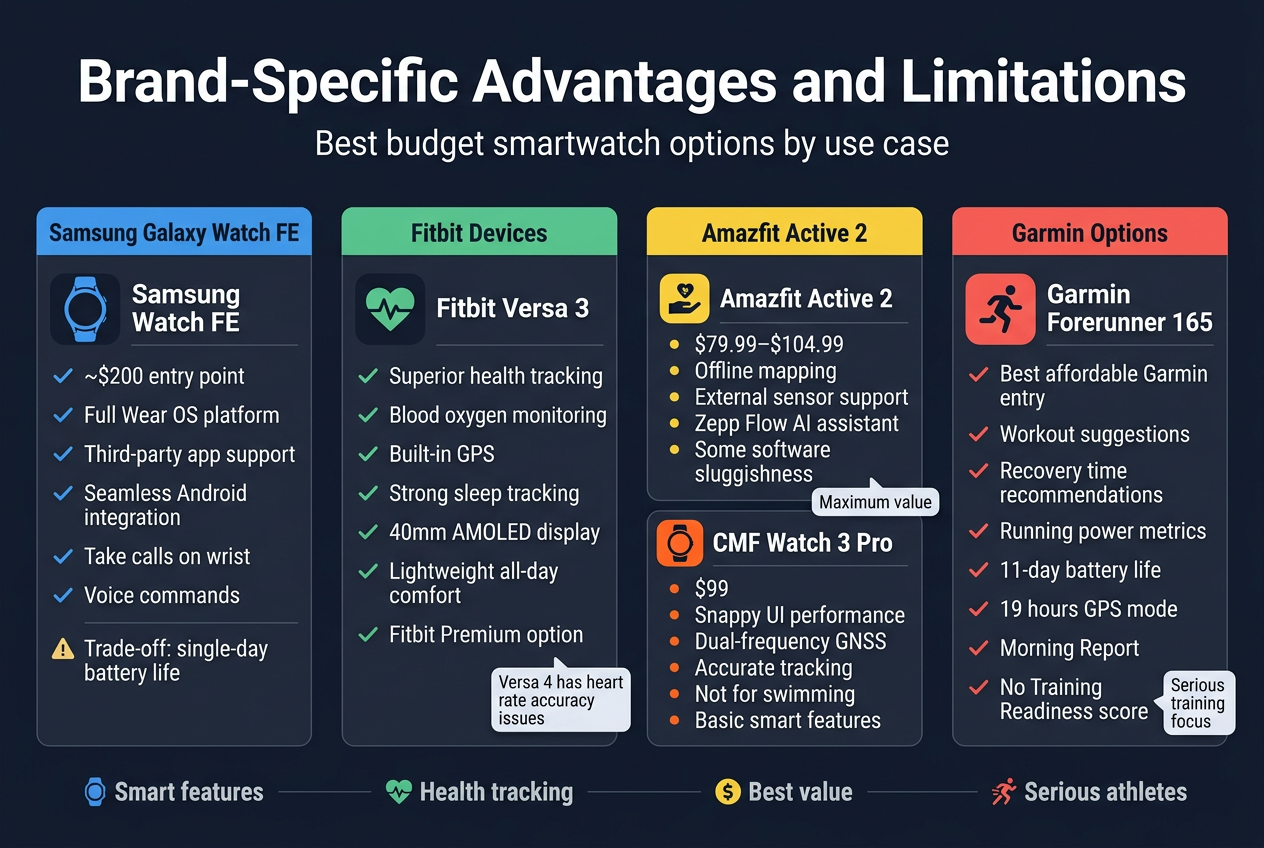
When you’re looking for comprehensive smart features without breaking the bank, Samsung’s Galaxy Watch FE stands out as your best entry point into the Galaxy ecosystem. While you’ll pay around $200 for this experience, you’re getting access to a full Wear OS platform that Samsung has refined over years of development.
The Galaxy Watch FE delivers the complete Samsung smartwatch experience with third-party app support, seamless integration with Android phones, and Samsung’s polished user interface. You can take calls directly on your wrist, use voice commands, and access a robust app ecosystem that rivals more expensive models. However, you’ll need to accept single-day battery life as a trade-off for these advanced features.
Fitbit Devices for Health-Focused Users
If your primary focus is health and fitness tracking, the Fitbit Versa 3 represents exceptional value in the budget smartwatch market. You’ll find this model offers superior health monitoring capabilities compared to its successor, the Versa 4, which received poor reviews for heart rate accuracy issues.
The Versa 3 provides you with blood oxygen monitoring, built-in GPS, and Fitbit’s renowned sleep tracking capabilities. Your investment includes access to Fitbit’s comprehensive health ecosystem, with the option to upgrade to Fitbit Premium for enhanced insights. The 40mm AMOLED display delivers bright, clear visuals, while the lightweight design ensures comfortable all-day wear during your fitness activities.
Amazfit and CMF for Maximum Value
For maximum value without sacrificing functionality, you’ll want to consider both Amazfit and CMF options that punch well above their weight class.
The Amazfit Active 2, priced at just $79.99-$104.99, redefines what you should expect from a budget smartwatch. You’ll get offline mapping capabilities, external sensor support, and a Zepp Flow AI assistant – features typically reserved for much more expensive devices. While you might experience some software sluggishness when using demanding features, the sheer number of capabilities packed into this price point makes it nearly unbeatable.
Similarly, the CMF Watch 3 Pro at $99 sets a new standard for budget aesthetics and functionality. You’ll appreciate its Nothing-inspired monochrome design and incredibly snappy UI performance. The dual-frequency GNSS tracking delivers accuracy comparable to watches three times the price, though you’ll need to accept limitations like no swimming capability and basic smart features.
Garmin Options for Serious Athletes
When you’re serious about athletic training and need reliable sports tracking, the Garmin Forerunner 165 represents your best affordable entry into Garmin’s ecosystem. While it’s the most expensive option in this budget category, you’re investing in proven training technology that serious athletes rely on.
You’ll benefit from Garmin’s advanced training features including workout suggestions, recovery time recommendations, and running power metrics. The 11-day battery life (19 hours in GPS mode) ensures your training sessions won’t be interrupted by charging needs. Though you won’t get some premium Garmin features like Training Readiness scores, the comprehensive training tools and Morning Report functionality provide substantial value for dedicated athletes looking to improve their performance.
Making the Right Choice for Your Lifestyle
Determining Your Primary Use Cases and Priorities
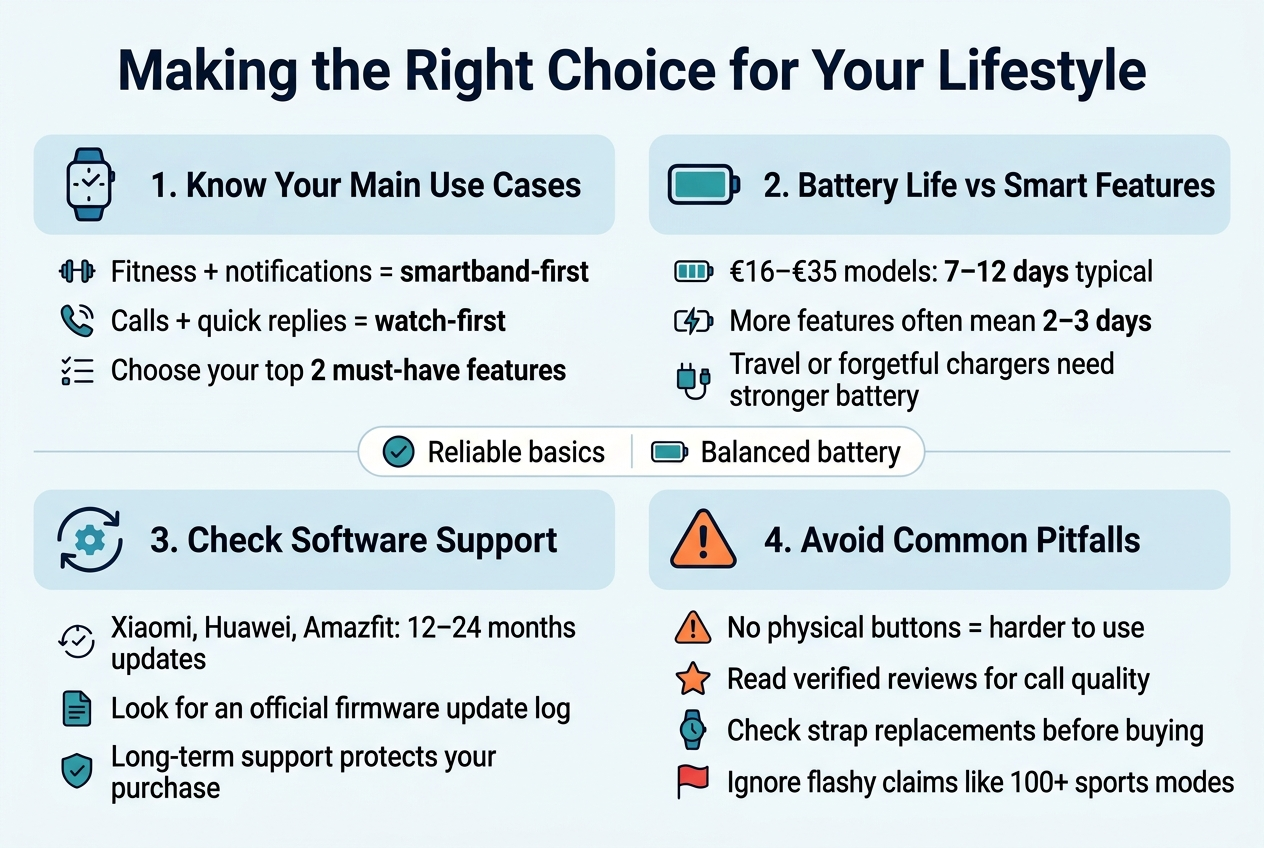
Before diving into any cheap smartwatch purchase, you need to honestly assess how you’ll actually use the device daily. If you’re primarily interested in fitness tracking and basic notifications, a simple smartband-first approach like the Xiaomi Smart Band 10 might serve you better than a full-featured watch. However, if you envision yourself taking hands-free calls while commuting or need quick reply options for work messages, you’ll want to focus on watch-first models with reliable Bluetooth calling capabilities.
Your lifestyle patterns should drive your decision-making process. Shift workers who need silent alerts will prioritize vibration strength and notification reliability, while fitness beginners might focus on heart rate accuracy and sleep tracking features. Students and remote employees often benefit most from models that offer customizable watch faces and easy strap swapping for different occasions.
Consider creating a simple priority list: identify your top two must-have features, such as “I must answer calls hands-free” or “I need 10-day battery between charges.” This approach prevents you from getting overwhelmed by marketing claims about 100+ sports modes or advanced metrics you’ll never actually use.
Balancing Smart Features Against Battery Life
One of the most critical trade-offs in budget smartwatches involves choosing between advanced smart features and extended battery life. Models in the €16-€35 range like the Redmi Watch 5 Active typically offer 7-12 days of battery life with moderate use, but this assumes you’re not heavily utilizing Bluetooth calling or always-on display features.
When manufacturers claim battery life exceeding 15 days, they usually assume disabled heart rate monitoring and minimal call usage. You’ll need to decide whether features like AI-enhanced call handling, dual-band GPS, and AMOLED always-on displays are worth reducing your battery life to 2-3 days, similar to premium smartwatches.
If you habitually charge devices nightly and keep your phone nearby, shorter battery life might not concern you. However, if you frequently forget to charge weekly or travel often, prioritize models known for consistently exceeding their battery claims. Customer feedback consistently shows that Redmi and CMF models often surpass their advertised battery performance, while some ultra-budget options under €20 struggle to meet basic claims.
Understanding Long-term Software Support and Updates
Software support varies dramatically across budget smartwatch brands, and this factor often determines whether your device remains functional beyond the first year. Reputable brands like Xiaomi, Huawei, and Amazfit typically provide 12-24 months of firmware updates for their budget models, while lesser-known brands may abandon support after the initial release.
Before purchasing, check the official support page for your specific model to verify update history. Models running lightweight but updatable operating systems like HyperOS or Zepp Lite generally receive more consistent patches than devices using basic RTOS platforms. The CMF Watch 3 Pro, for example, offers confirmed firmware support for at least two years, justifying its higher price point in the €80-101 range.
You should avoid models with no visible firmware update log beyond their initial release. Brands that treat entry-tier models as brand ambassadors rather than loss leaders tend to maintain better long-term support, ensuring your investment remains secure as smartphone operating systems evolve.
Avoiding Common Pitfalls When Buying Budget Smartwatches
Several red flags should immediately disqualify budget smartwatch options from your consideration. Models without physical buttons often create frustrating user experiences, especially during exercise or when wearing gloves. Touch-only navigation may seem modern, but users overwhelmingly prefer tactile feedback to reduce mis-taps during movement.
Verify Bluetooth calling implementation through verified buyer reviews rather than relying on product descriptions. Look specifically for mentions of “call quality,” “mic pickup,” or “speaker distortion” in 4-star and above reviews. Avoid any model where more than 30% of positive reviews cite one-way audio issues or unusable speaker volume.
Check strap replacement availability before purchasing by searching “[model name] + strap” on major retailers. If only one vendor sells replacements or prices exceed €8, it indicates poor long-term usability. Models under €15 often use proprietary straps with no aftermarket options, essentially making them disposable devices.
Be skeptical of marketing claims like “100+ sports modes” when only 5 activities auto-detect properly, or “SpO2 monitoring” that’s only calibrated for lab conditions. Features like “dual-band GPS” without GLONASS/Galileo support are common in €15-25 watches but provide little real-world benefit. Focus on core functionality that works consistently rather than impressive-sounding features that underperform.
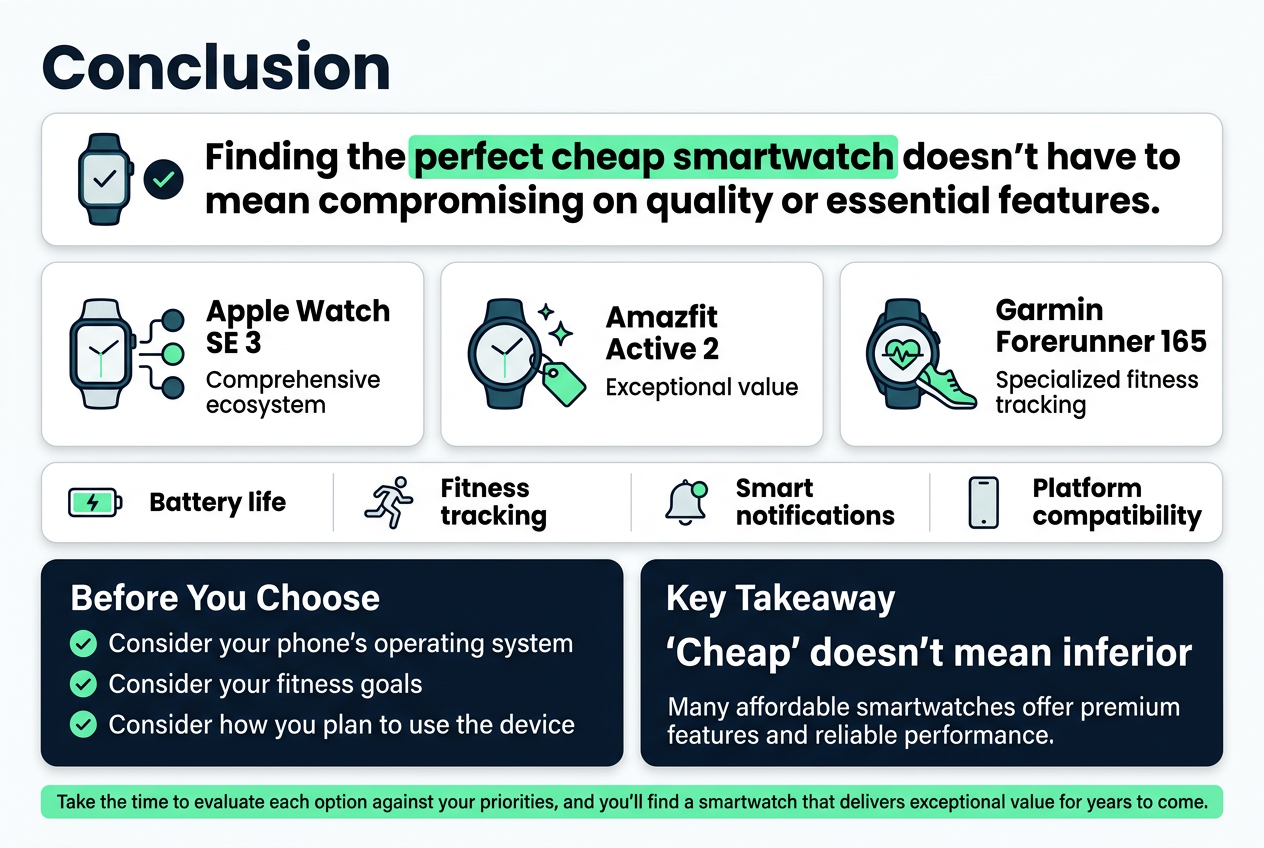
Finding the perfect cheap smartwatch doesn’t have to mean compromising on quality or essential features. Whether you’re drawn to the comprehensive ecosystem of an Apple Watch SE 3, the exceptional value of an Amazfit Active 2, or the specialized fitness tracking of a Garmin Forerunner 165, there’s a budget-friendly option that matches your specific needs and lifestyle. The key is understanding what features matter most to you – from battery life and fitness tracking capabilities to smart notifications and platform compatibility.
Your smartwatch choice should enhance your daily routine without breaking the bank. Consider your phone’s operating system, your fitness goals, and how you plan to use the device before making your decision. Remember that “cheap” doesn’t mean inferior – many of these affordable options offer premium features and reliable performance that rival their more expensive counterparts. Take the time to evaluate each option against your priorities, and you’ll find a smartwatch that delivers exceptional value for years to come.
