
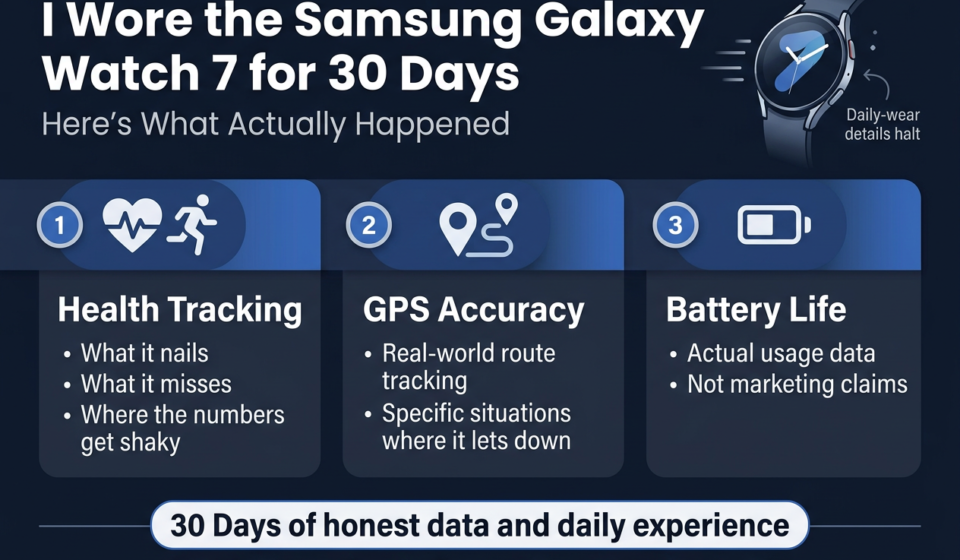

I Wore the Samsung Galaxy Watch 7 for 30 Days — Here’s What Actually Happened
If you’re trying to figure out whether the Samsung Galaxy Watch 7 is worth your money, you’re in the right place. This isn’t a quick unboxing take — this is a real Samsung Galaxy Watch 7 long-term review after 30 days of daily wear, workouts, sleep tracking, and everything in between.
This review is for you if you’re an Android user shopping for a capable smartwatch under $350 and want straight answers before you spend your money.
Here’s what you’ll get from reading this all the way through:
- A real look at Galaxy Watch 7 health tracking performance — what it nails, what it misses, and where the numbers get a little shaky
- The truth about Samsung Galaxy Watch 7 GPS accuracy, including the specific situations where it consistently lets you down
- A breakdown of Galaxy Watch 7 battery life based on actual usage data, not Samsung’s marketing claims
No fluff, no hype. Just 30 days of honest data and daily experience to help you decide if this watch belongs on your wrist.
Key Specs and Pricing at a Glance
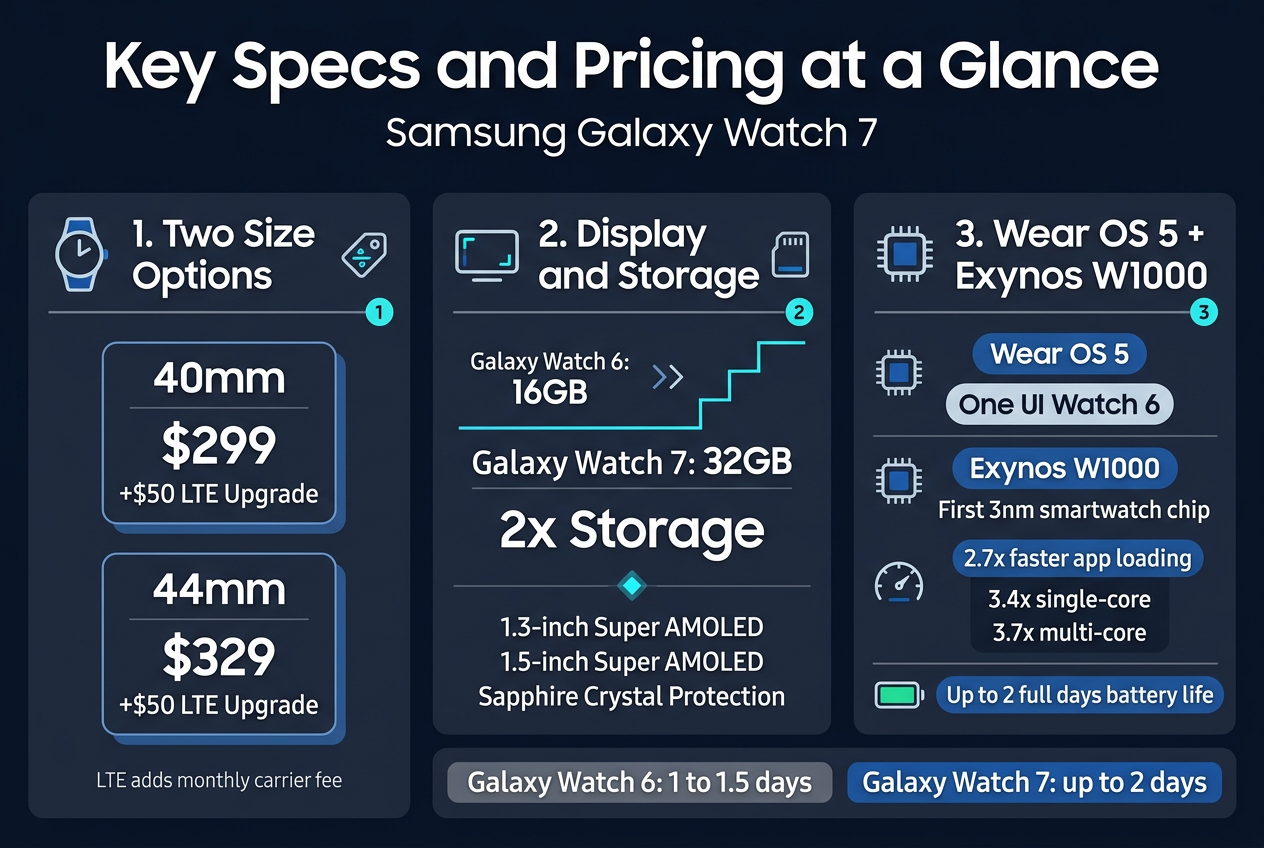
Two Size Options: 40mm ($299) and 44mm ($329) with LTE Upgrades Available
The Samsung Galaxy Watch 7 gives you two size options to match your wrist and budget. The 40mm model starts at $299, while the 44mm variant comes in at $329. If you want cellular independence from your phone, you can add LTE support to either size for an extra $50, though keep in mind you’ll also pay a monthly carrier fee on top of that.
| Model | Price | LTE Upgrade |
|---|---|---|
| Galaxy Watch 7 40mm | $299 | +$50 |
| Galaxy Watch 7 44mm | $329 | +$50 |
Display, Processor, and Storage Upgrades Over the Previous Model
Compared to the Galaxy Watch 6, your Watch 7 brings a meaningful storage jump — doubling from 16GB to 32GB. In practice, the Watch 6’s 16GB shrank to roughly 6GB after the OS took its share, so this upgrade gives you genuine room for music, podcasts, and apps. The display specs — 1.3-inch (40mm) and 1.5-inch (44mm) Super AMOLED panels with sapphire crystal protection — remain the same, but performance sees a dramatic leap.
WearOS 5 with Samsung One UI and the New 3nm Exynos W1000 Chip
Your Galaxy Watch 7 runs on Wear OS 5 wrapped in Samsung’s One UI Watch 6, powered by the brand-new Exynos W1000 — Samsung’s first 3nm chip in a smartwatch. This penta-core processor reportedly loads apps 2.7x faster than the Exynos W930 in the Watch 6, with single-core and multi-core performance improvements of 3.4x and 3.7x, respectively. Beyond speed, its efficiency helps squeeze out roughly two full days of battery life per charge — a noticeable improvement over the Watch 6’s 1 to 1.5-day average. With this in mind, next, we’ll explore how the design and build quality hold up in real-world use.
Design and Build Quality Worth Praising
A. Unchanged but Premium Aluminum Casing with Lightweight Comfort
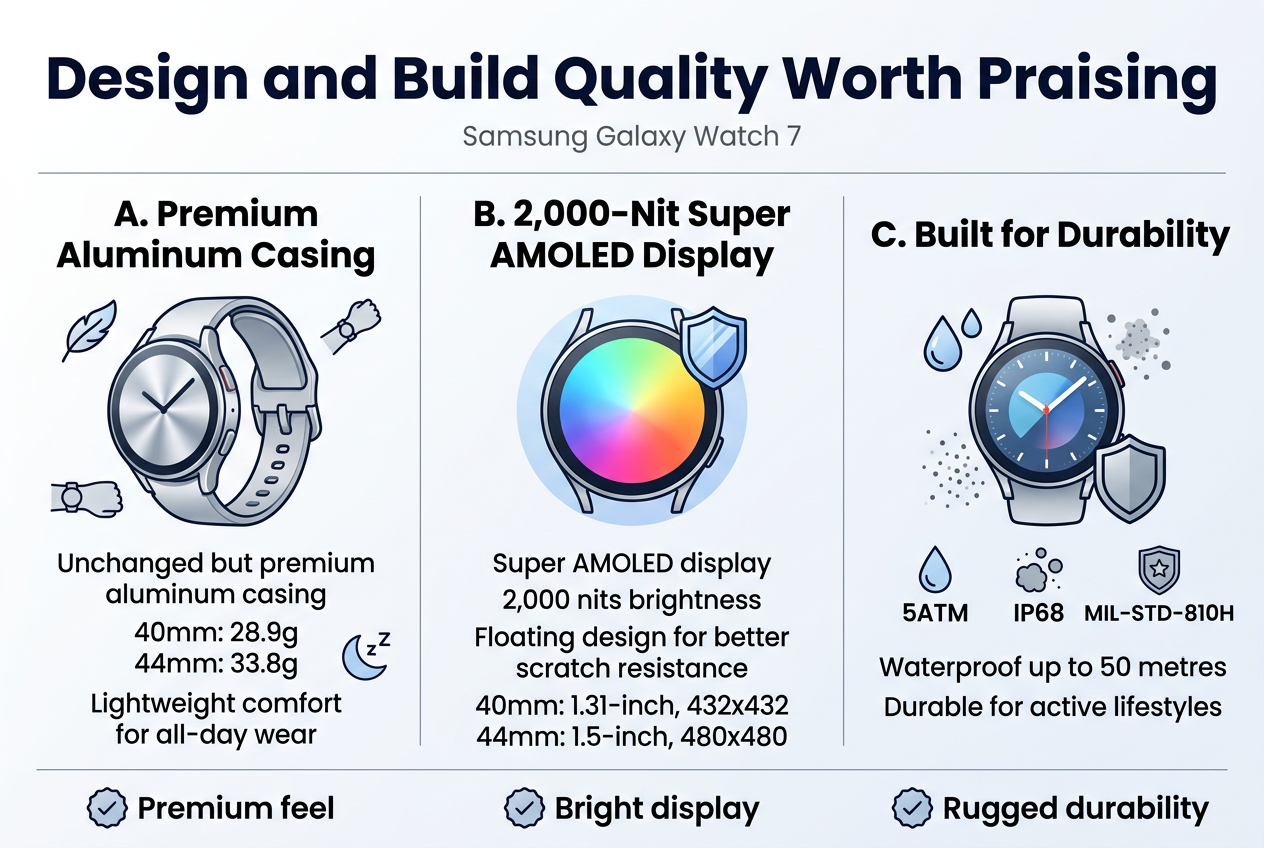
When you first strap on the Samsung Galaxy Watch 7, you might notice it looks nearly identical to its predecessor, the Galaxy Watch 6. However, don’t let that fool you — the aluminum build feels genuinely premium on your wrist. At just 28.9g for the 40mm model and 33.8g for the 44mm, it’s remarkably lightweight, and after a couple of days, you’ll barely notice you’re wearing it, even during sleep.
B. Stunning 2,000-Nit Super AMOLED Display with Sapphire Glass
The round Super AMOLED display delivers rich, vibrant colors with plenty of pop — exactly what you’d expect from a Samsung screen. What you’ll appreciate is the slightly raised “floating” design, which makes the display harder to scratch in everyday use. The 40mm model offers a 1.31-inch, 432×432 pixel resolution, while the 44mm steps up to 1.5 inches at 480×480, giving your wrist a stunning, crystal-clear visual experience.
C. Solid Durability with 5ATM, IP68, and MIL-STD-810H Ratings
If you lead an active lifestyle, you’ll be glad to know the Galaxy Watch 7 is built to handle it. With waterproofing up to 50 metres, an IP68 rating, and MIL-STD-810H military-grade durability certification, this watch can take on water, dust, and tough environmental conditions without breaking a sweat — giving you reliable peace of mind no matter where your day takes you.
Exciting New Features That Set It Apart
Dual-Frequency GNSS GPS for Improved Location Accuracy
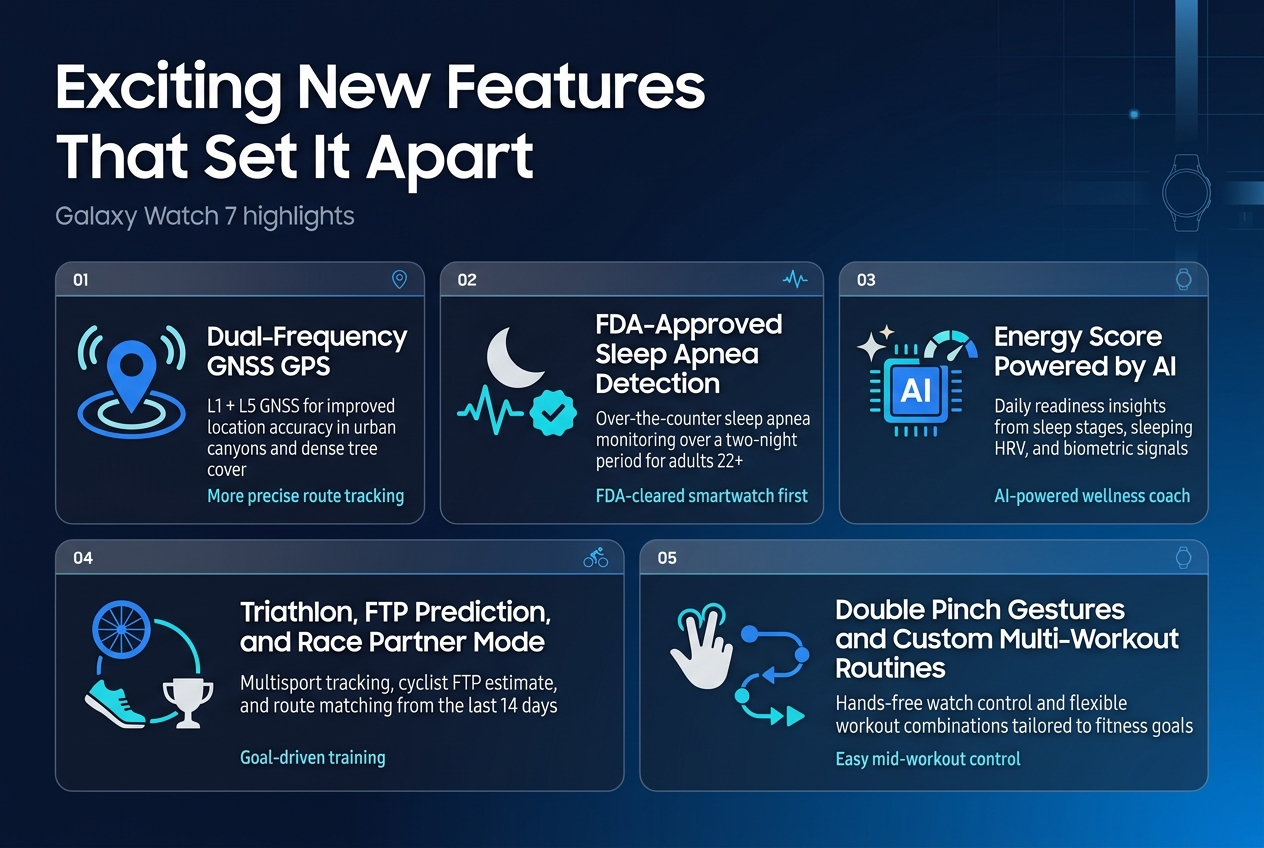
The Galaxy Watch 7 upgrades from single-frequency L1 GPS (found on the Watch 6) to dual-frequency L1+L5 GNSS, which means your location tracking is far more precise — especially in urban canyons or dense tree cover where signal interference is common. If you run or cycle through challenging environments, this hardware-level improvement directly benefits your route accuracy and workout data reliability.
FDA-Approved Sleep Apnea Detection – A Smartwatch First
One of the most significant Galaxy Watch 7 features you’ll appreciate is its FDA-cleared Sleep Apnea detection, which monitors significant breathing disruptions over a two-night period. Designed for adults 22 and older without a prior sleep apnea diagnosis, this over-the-counter software tool works alongside your compatible Samsung Galaxy phone. It’s a genuine smartwatch first that gives your nightly health monitoring a whole new level of clinical credibility.
Energy Score Powered by AI for Daily Readiness Insights
Your Galaxy Watch 7 uses Galaxy AI to deliver an Energy Score each day, pulling in data from sleep stages, sleeping HRV, and other biometric signals to give you a personalized readiness snapshot. This helps you make smarter decisions about training intensity, recovery, and daily activity — essentially acting as your AI-powered wellness coach right on your wrist.
Triathlon/Multisport Mode, Cycling FTP Prediction, and Race Partner Mode
For serious athletes, the Galaxy Watch 7 supports multisport tracking and introduces a personalized Functional Threshold Power (FTP) estimate for cyclists. Paired with a compatible power meter and your Samsung Galaxy smartphone, Galaxy AI calculates your FTP based on your own heart rate data — no expensive lab testing required. The Race Partner mode lets you follow the same starting point and path as a previous workout logged within the last 14 days, keeping your outdoor running and cycling competitive and goal-driven.
Double Pinch Gestures and Customizable Multi-Workout Routines
With the Galaxy Watch 7, your interaction with the watch goes beyond tapping the screen. Double Pinch gestures give you a hands-free way to control the watch mid-workout, which is incredibly useful when your hands are occupied. Combined with customizable multi-workout routines, you can string together exercise sessions tailored to your fitness goals — making it one of the more flexible and user-friendly smartwatches in its category.
Health and Fitness Tracking Performance
Improved BioActive Sensor Delivers Responsive Heart Rate Monitoring
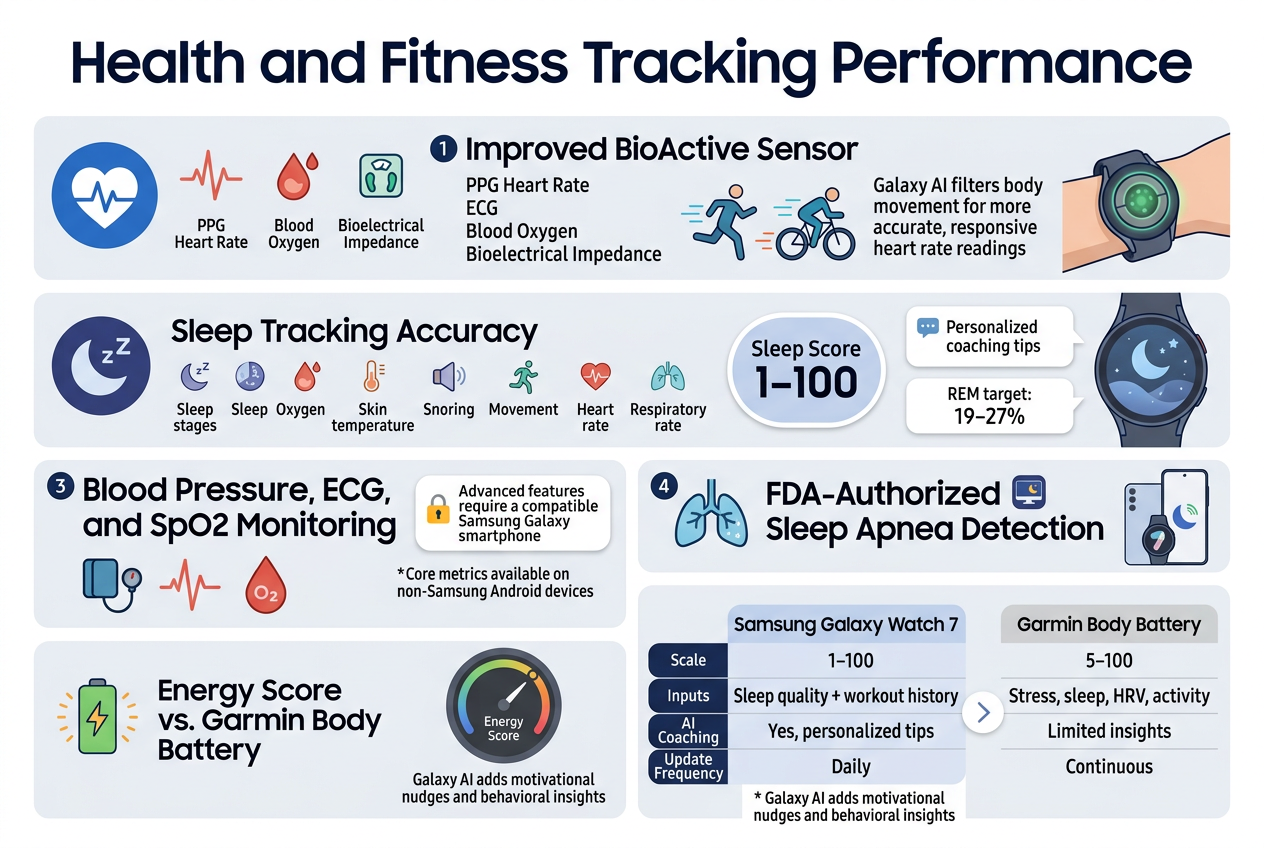
The upgraded Samsung BioActive sensor is one of the standout reasons to consider the Galaxy Watch 7 for your Galaxy Watch 7 health tracking needs. It combines PPG heart rate monitoring, ECG, blood oxygen reading, and bioelectrical impedance analysis into a single sensor. Thanks to Galaxy AI filtering out body movements during workouts, your heart rate readings are noticeably more accurate and responsive compared to previous Galaxy Watch models, giving you reliable data whether you’re cycling, hiking, or simply going about your day.
Sleep Tracking Accuracy and Helpful Sleep Score Coaching
Your sleep data on the Galaxy Watch 7 is impressively detailed, covering sleep stages, blood oxygen levels, skin temperature, snoring, body movement, heart rate, and respiratory rate — all available after just one night of use. The AI-powered Sleep Score (scaled 1–100) delivers personalized coaching tips, helping you understand long-term trends. For example, you’ll learn that someone your age should spend 19–27% of sleep time in REM — and the watch tracks whether you’re hitting that target nightly.
Blood Pressure, ECG, and SpO2 Monitoring With Some Samsung-Only Limitations
The BioActive sensor handles ECG and SpO2 monitoring directly from your wrist, and features like FDA-authorized sleep apnea detection add a meaningful layer of health oversight to your daily routine. However, you should know that the most advanced capabilities — including sleep apnea detection and detailed health insights — require pairing with a compatible Samsung Galaxy smartphone. If you’re using a non-Samsung Android device, you’ll still get core metrics, but you’ll miss out on the deeper AI-powered analysis that truly sets this watch apart.
Energy Score vs. Garmin Body Battery – How It Compares
| Feature | Samsung Galaxy Watch 7 | Garmin Body Battery |
|---|---|---|
| Scale | 1–100 | 5–100 |
| Inputs | Sleep quality + workout history | Stress, sleep, HRV, activity |
| AI Coaching | Yes, personalized tips | Limited insights |
| Update Frequency | Daily | Continuous |
Your daily Energy Score on the Galaxy Watch 7 factors in both your sleep quality and your previous workout efforts, functioning similarly to Garmin’s Body Battery. The key difference is that Samsung layers Galaxy AI coaching on top, offering motivational nudges and behavioral insights — like flagging that late-night snacking hurt your recovery — making it a genuinely actionable wellness tool rather than just a number on your wrist.
GPS Accuracy Issues You Should Know About
Multiband GPS Struggles in Forests and Open-Water Swimming
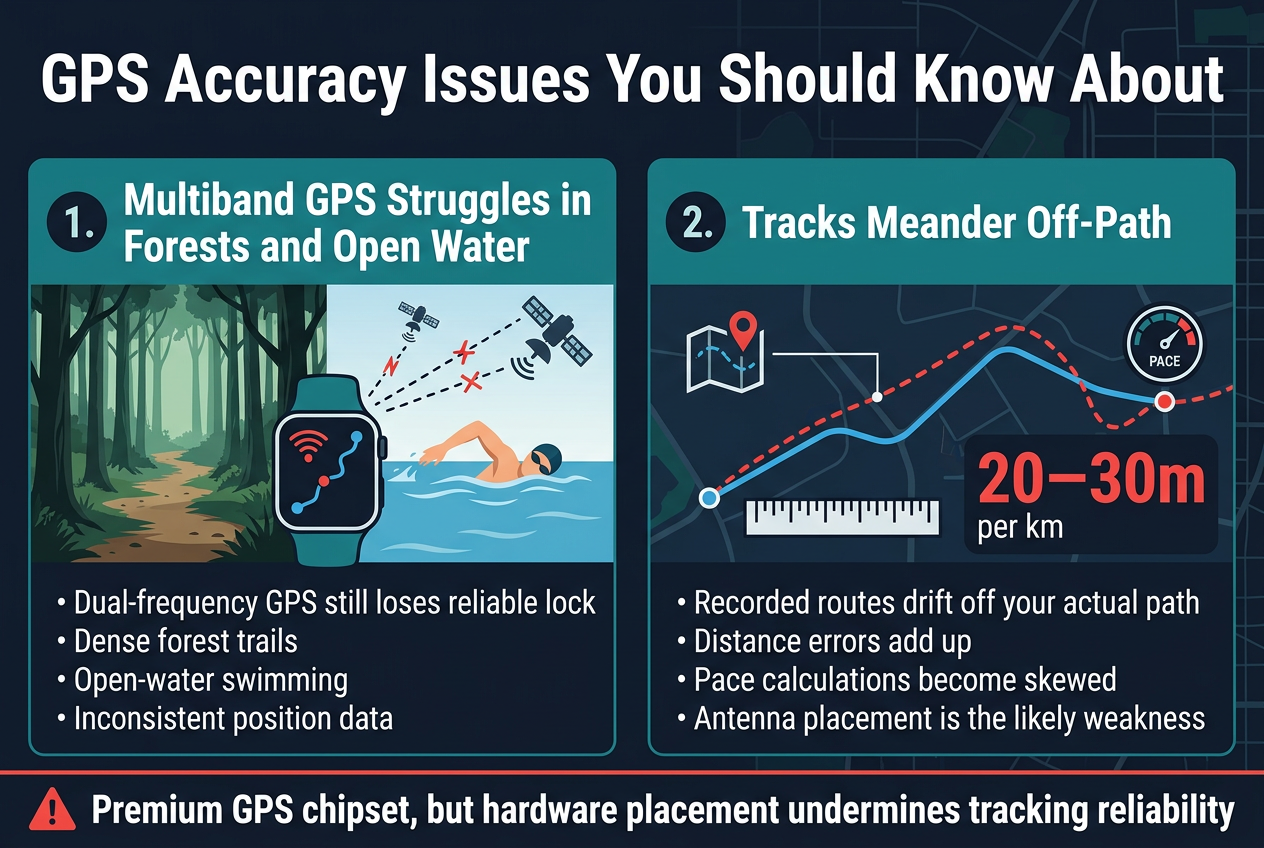
Despite featuring dual-frequency GPS, the Samsung Galaxy Watch 7 GPS accuracy falters in challenging environments. If you swim in open water or run through dense forest trails, you’ll notice the watch loses reliable satellite lock, causing inconsistent position data. These are precisely the conditions where you’d expect multiband GPS to shine, making this a frustrating shortcoming for serious outdoor athletes.
Tracks Meander Off-Path, Adding 20–30m Per km in Distance Errors
You’ll likely see your recorded routes drifting noticeably off your actual path, adding approximately 20–30 meters of error per kilometer. This directly inflates your logged distances and skews pace calculations. The antenna design is widely suspected as the culprit, even though the watch carries a premium GPS chipset — meaning hardware placement, not processing power, appears to be undermining your tracking reliability.
Real-World Battery Life Results
A. Typical Usage Yields Roughly 1.5 Days on a Single Charge
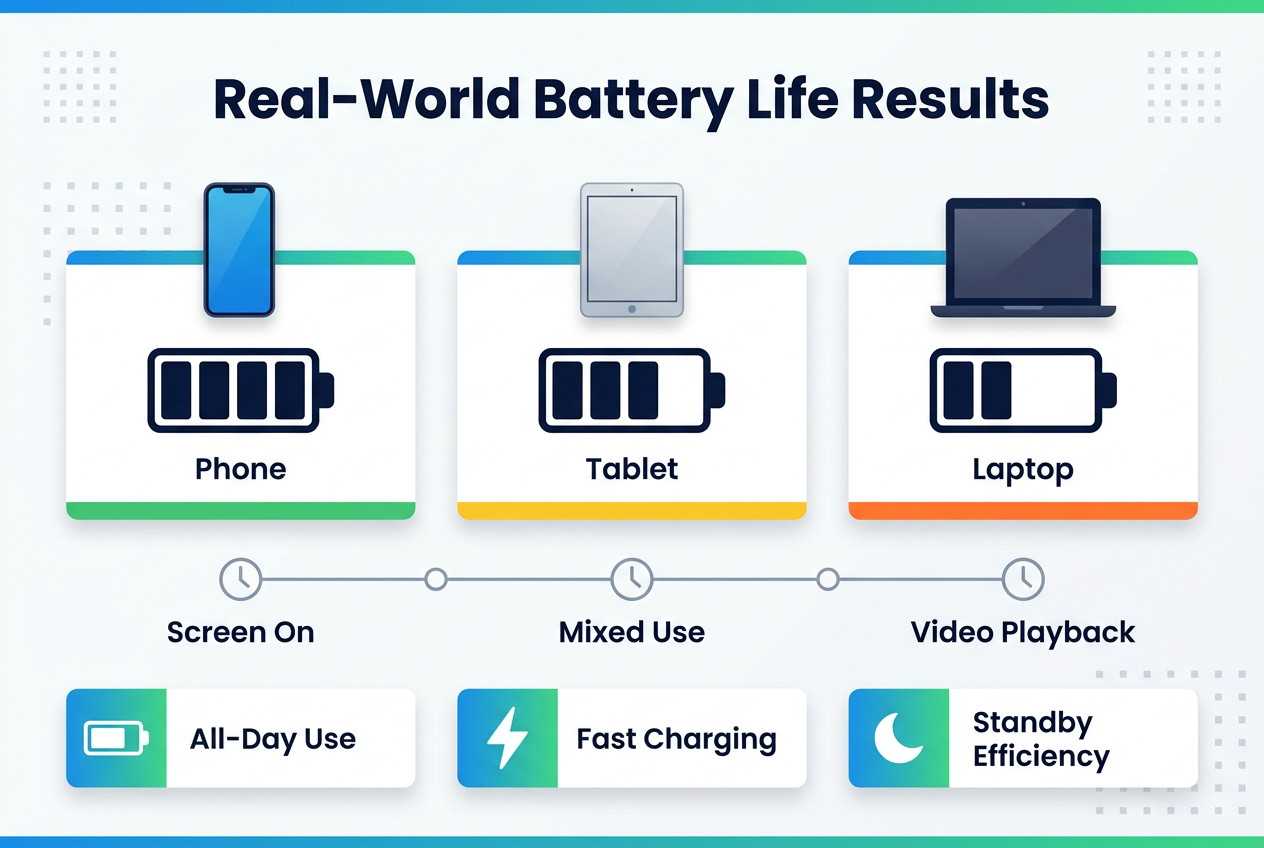
In your day-to-day use, the Samsung Galaxy Watch 7 battery life will likely leave you wanting more. With always-on display, heart rate monitoring, and notifications running, you’re looking at roughly 1.5 days before you need to reach for the charger. If you turn off the always-on display and scale back background tracking, you might squeeze closer to two days — but realistically, plan on charging every night.
B. GPS-Heavy Workouts Drain Battery Faster Than Expected
If you’re an outdoor runner or cyclist, your Samsung Watch 7 battery life takes a serious hit during GPS sessions. A 60-minute GPS workout can chew through 15–20% of your battery, meaning back-to-back training days become a juggling act. Pair that with the slow 15W charging speed, and you’re waiting nearly an hour for a full charge — making those quick morning top-ups before a workout genuinely frustrating. Keep a charger nearby if you train daily.
| Usage Type | Estimated Battery Drain |
|---|---|
| Daily typical use | ~1.5 days |
| Always-on display off | ~2 days |
| 60-min GPS workout | 15–20% |
| Full charge time | ~60 minutes |
Samsung-Exclusive Features That Limit Non-Samsung Users
ECG, Blood Pressure, and Irregular Heart Rhythm Alerts Require Samsung Phones
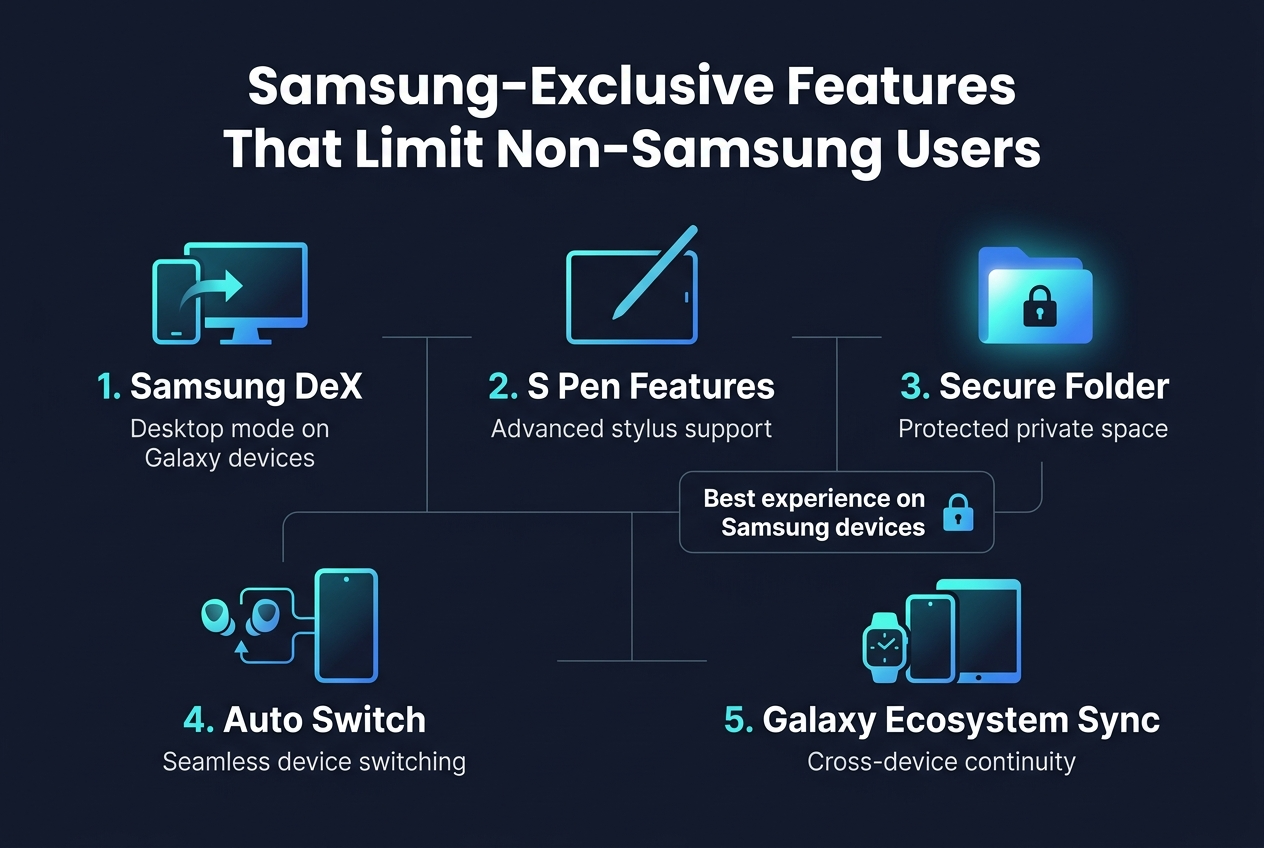
Some of the Galaxy Watch 7’s most impressive health features — ECG, blood pressure monitoring, and irregular heart rhythm alerts — are locked exclusively to Samsung Galaxy phones. If you’re rocking an iPhone or a non-Samsung Android device, these tools simply won’t work for you. That’s a significant limitation when these features are core selling points of the watch.
Sleep Apnea Detection Also Locked to Galaxy Phone Users
Your ability to get the full value from this watch depends heavily on whether you’re already in Samsung’s ecosystem. Sleep Apnea detection, one of the standout new Galaxy Watch 7 features, is also restricted to Galaxy phone users. If you’re considering switching from a competitor, these locked features should seriously factor into your buying decision before you commit.
Is the Samsung Galaxy Watch 7 Worth Buying?
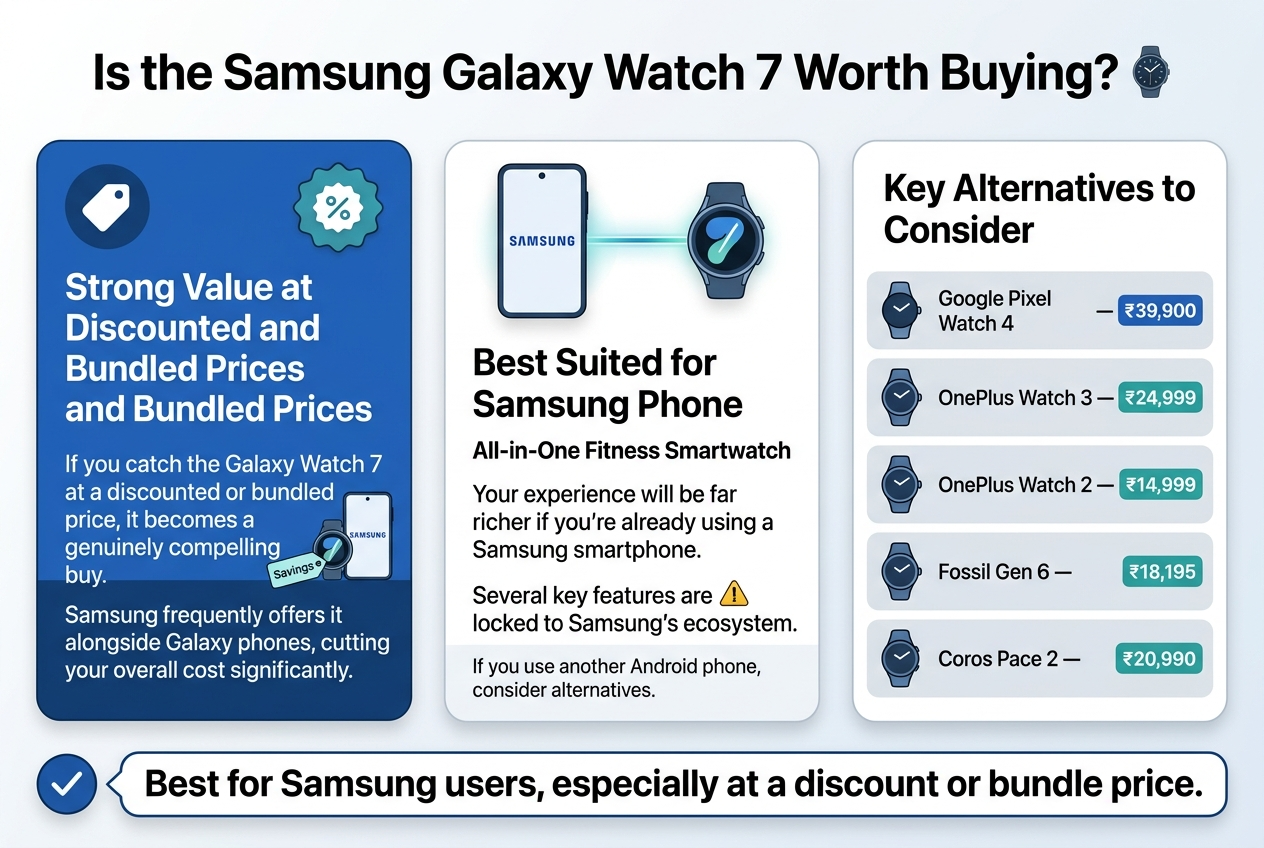
Strong Value at Discounted and Bundled Prices
If you catch the Galaxy Watch 7 at a discounted or bundled price, it becomes a genuinely compelling buy. Samsung frequently offers it alongside Galaxy phones, which cuts your overall cost significantly and makes it easier to justify the purchase.
Best Suited for Samsung Phone Users Seeking an All-In-One Fitness Smartwatch
Your experience with the Galaxy Watch 7 will be far richer if you’re already using a Samsung smartphone, as several key features are locked to Samsung’s ecosystem. If you’re an Android user outside Samsung’s lineup, alternatives like the Google Pixel Watch 4 (₹39,900) or the OnePlus Watch 3 (₹24,999) may serve you better. For budget-conscious buyers, options like the OnePlus Watch 2 (₹14,999) are also worth considering.
Key Alternatives to Consider
| Watch | Price (India) |
|---|---|
| Google Pixel Watch 4 | ₹39,900 |
| OnePlus Watch 3 | ₹24,999 |
| OnePlus Watch 2 | ₹14,999 |
| Fossil Gen 6 | ₹18,195 |
| Coros Pace 2 | ₹20,990 |
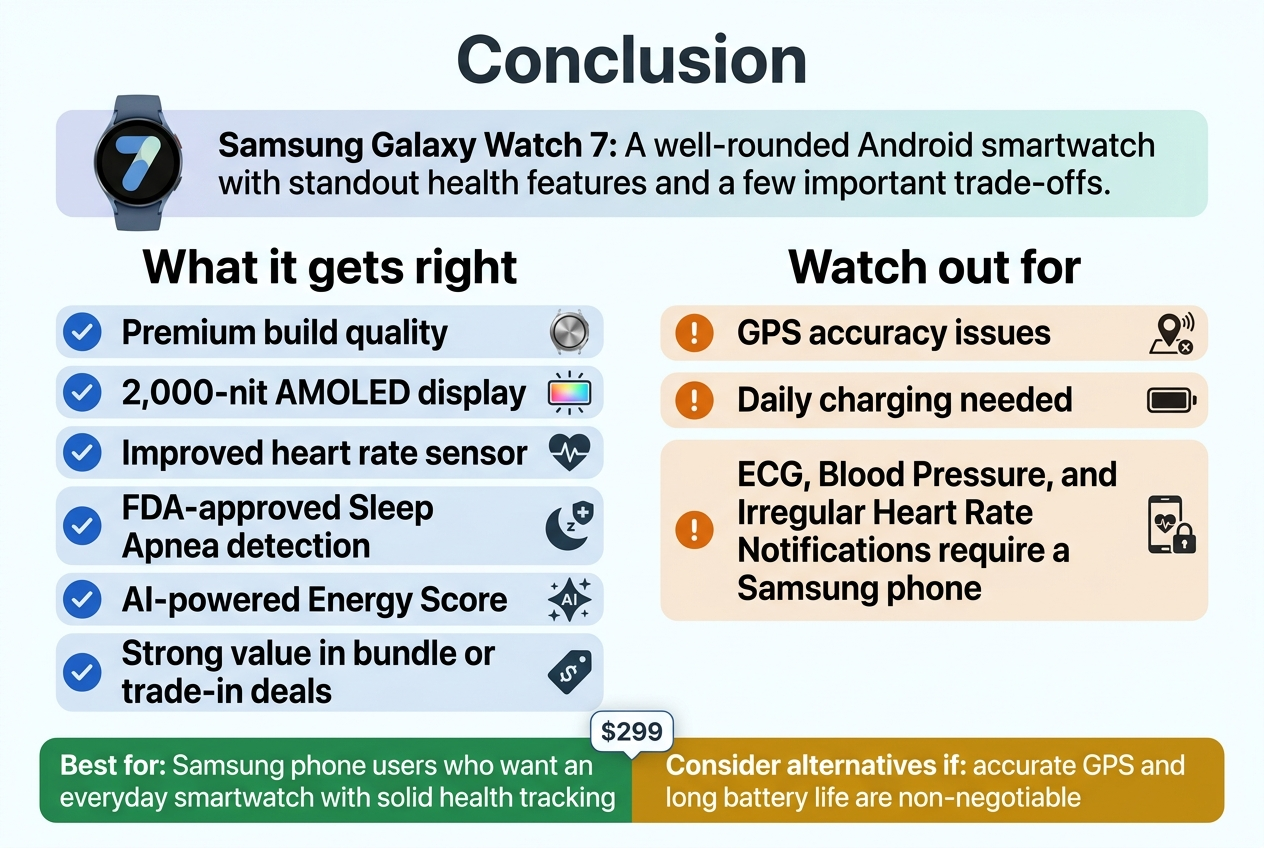
After 30 days with the Samsung Galaxy Watch 7, here’s the bottom line: it’s a genuinely impressive smartwatch that gets a lot right. The premium build quality, stunning 2,000-nit AMOLED display, improved heart rate sensor, FDA-approved Sleep Apnea detection, and useful AI-powered features like Energy Score make it one of the more well-rounded Android smartwatches available today. If you snag it as part of a phone bundle or trade-in deal, the value proposition becomes even harder to ignore.
That said, it’s not without its flaws. The GPS accuracy issues are real and worth taking seriously if you rely on precise tracking for running, cycling, or open-water swimming. Battery life will likely require daily charging, and some of the best health features — ECG, Blood Pressure monitoring, and Irregular Heart Rate Notifications — are locked behind a Samsung phone. If you’re a Samsung phone user looking for a capable everyday smartwatch with solid health tracking, the Galaxy Watch 7 at $299 is absolutely worth your consideration. But if accurate GPS and extended battery life are non-negotiables for you, it may be worth weighing your options carefully before committing.


