
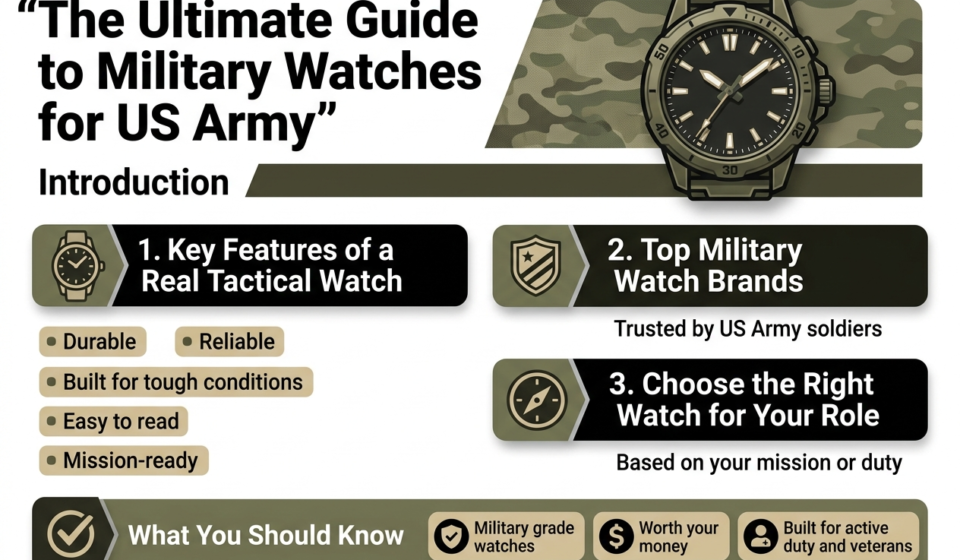

The Ultimate Guide to Military Watches for US Army
If you’re active duty, a veteran, or someone who needs a watch that can genuinely keep up with tough conditions, you’re in the right place. This guide breaks down everything you need to know about military watches for US Army personnel — no fluff, just the good stuff.
We’ll walk you through the key features that separate a real tactical watch for soldiers from a regular timepiece, highlight the top military watch brands that US Army soldiers actually trust, and cover how to pick the right one based on your specific mission or role.
By the end, you’ll know exactly what to look for in military grade watches — and which ones are worth your money.
Why Military Watches Matter for US Army Personnel
How Military Watches Differ from Civilian Timepieces
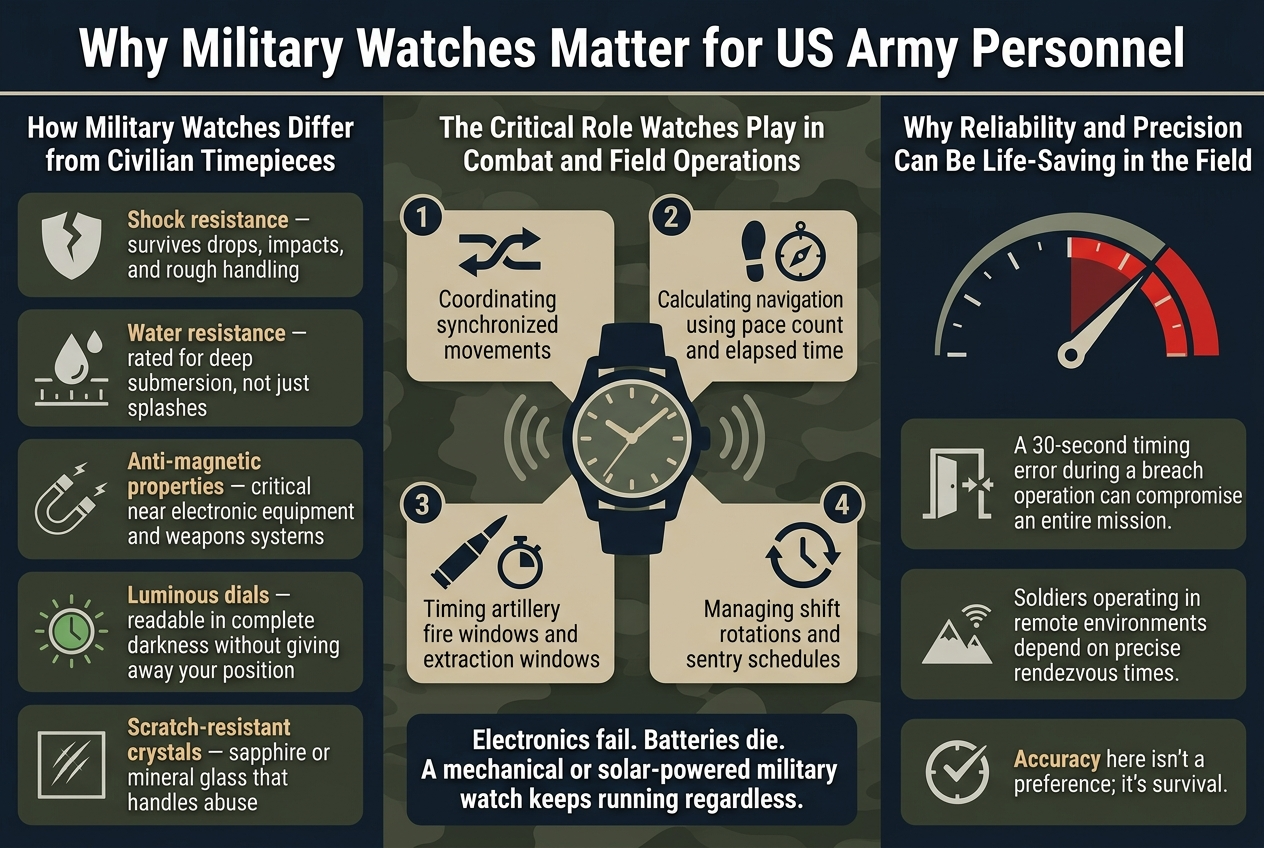
Military watches aren’t just regular watches with a camo strap. They’re built to a completely different standard:
- Shock resistance — designed to survive drops, impacts, and rough handling
- Water resistance — rated for deep submersion, not just splashes
- Anti-magnetic properties — critical near electronic equipment and weapons systems
- Luminous dials — readable in complete darkness without giving away your position
- Scratch-resistant crystals — sapphire or mineral glass that handles abuse
The Critical Role Watches Play in Combat and Field Operations
When radios go silent and GPS signals get jammed, a watch becomes your most trusted tool. Soldiers depend on watches for:
- Coordinating synchronized multi-unit movements
- Calculating navigation using pace count and elapsed time
- Timing artillery fire windows and extraction windows
- Managing shift rotations and sentry schedules
Electronics fail. Batteries die. A mechanical or solar-powered military watch keeps running regardless.
Why Reliability and Precision Can Be Life-Saving in the Field
A 30-second timing error during a breach operation can compromise an entire mission. Soldiers operating in remote environments — where rescue depends on precise rendezvous times — cannot afford a watch that drifts or quits under pressure. Accuracy here isn’t a preference; it’s survival.
Key Features to Look for in a Military Watch
Durability and Shock Resistance for Extreme Conditions
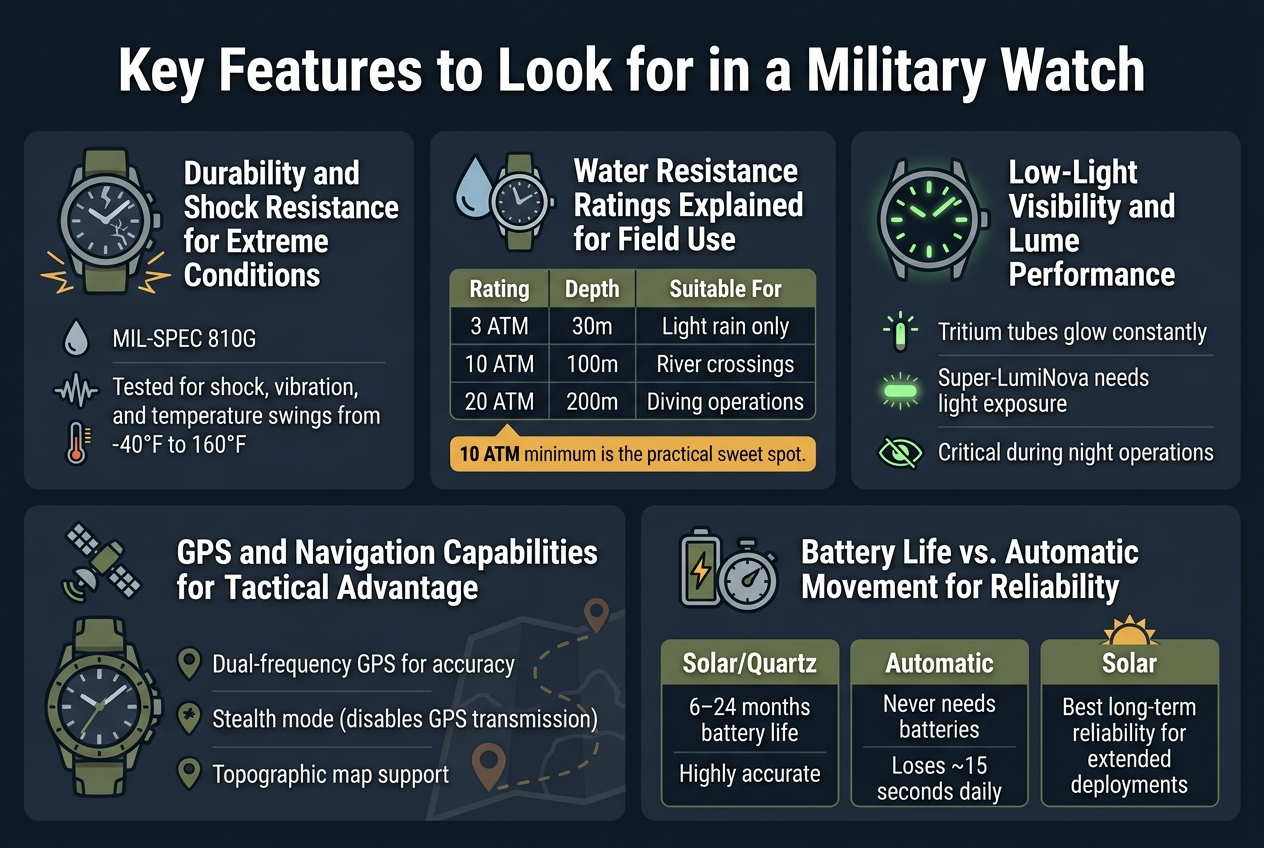
Military watches take serious punishment — drops, impacts, extreme temperatures, and rough terrain. Look for watches meeting MIL-SPEC 810G standards, which test resistance against shock, vibration, and temperature swings from -40°F to 160°F.
Water Resistance Ratings Explained for Field Use
| Rating | Depth | Suitable For |
|---|---|---|
| 3 ATM | 30m | Light rain only |
| 10 ATM | 100m | River crossings |
| 20 ATM | 200m | Diving operations |
For most field missions, 10 ATM minimum is the practical sweet spot.
Low-Light Visibility and Lume Performance
Tritium tubes outperform standard Super-LumiNova because they glow constantly without needing light exposure. Brands like Ball and Traser use tritium specifically for this reason — critical during night operations when charging a dial isn’t an option.
GPS and Navigation Capabilities for Tactical Advantage
GPS watches like the Garmin Tactix provide real-time positioning, waypoint tracking, and breadcrumb trails. Key features to prioritize:
- Dual-frequency GPS for accuracy
- Stealth mode (disables GPS transmission)
- Topographic map support
Battery Life vs. Automatic Movement for Reliability
- Solar/Quartz: 6–24 months battery life, highly accurate
- Automatic: Never needs batteries, but loses ~15 seconds daily
- Solar: Best long-term reliability for extended deployments
Top Military Watch Brands Trusted by US Army Soldiers
Casio G-Shock and Its Proven Track Record in the Field
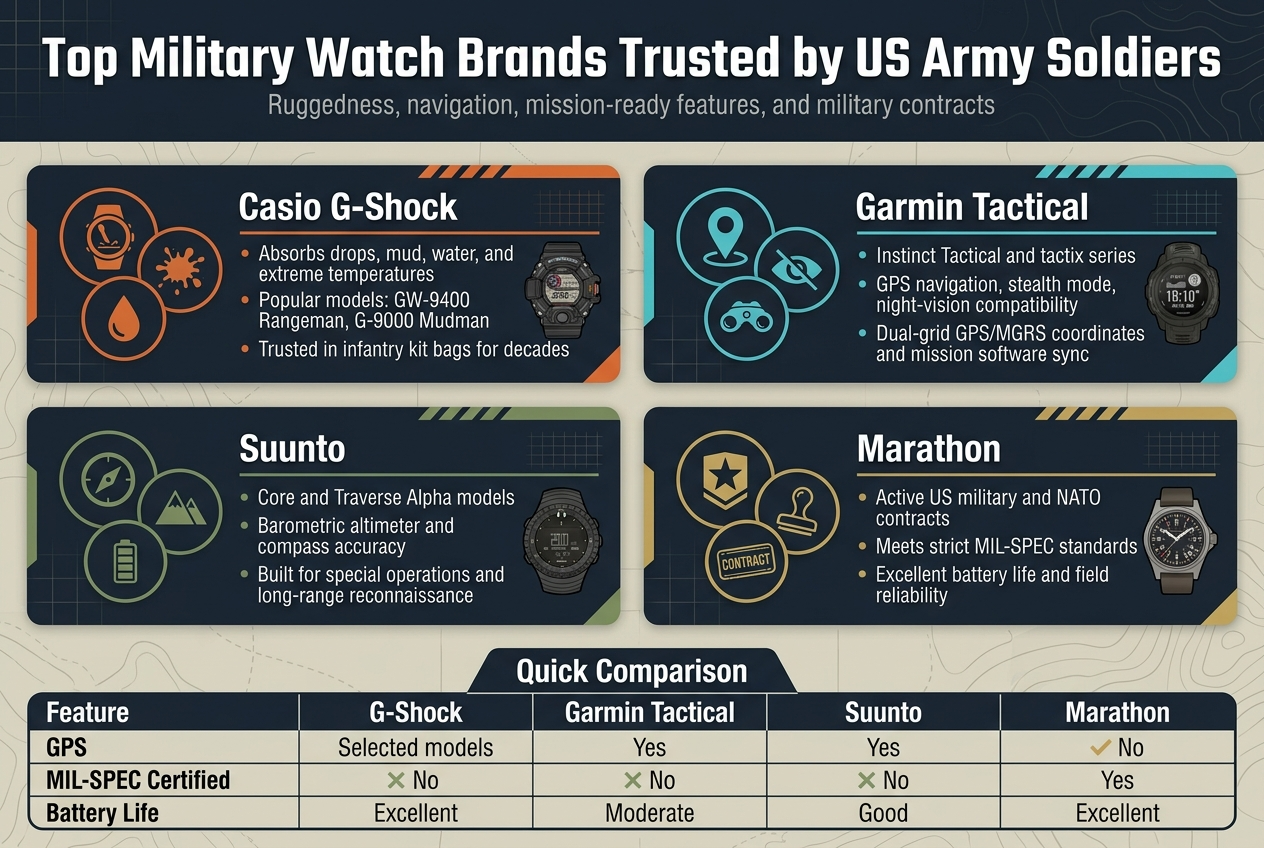
G-Shock watches have been a staple in military kit bags for decades. Soldiers trust them because they absorb punishment — drops, mud, water, and extreme temperatures — without skipping a beat. The GW-9400 Rangeman and G-9000 Mudman are particularly popular among infantry units.
Garmin Tactical Watches for Modern Army Operations
Garmin’s Instinct Tactical and tactix series bring GPS navigation, stealth mode, and night-vision compatibility to the wrist. These watches sync with mission planning software and support dual-grid GPS/MGRS coordinates — genuinely useful in the field.
Suunto Military Series for Endurance and Navigation
Suunto’s Core and Traverse Alpha models are built for special operations and long-range reconnaissance. Their barometric altimeters, compass accuracy, and battery life make them reliable companions during multi-day missions.
Marathon Watch Company and Its Official Military Contracts
Marathon holds active contracts with the US military and NATO allies — their watches meet strict MIL-SPEC standards.
| Feature | G-Shock | Garmin Tactical | Suunto | Marathon |
|---|---|---|---|---|
| GPS | Selected models | Yes | Yes | No |
| MIL-SPEC Certified | No | No | No | Yes |
| Battery Life | Excellent | Moderate | Good | Excellent |
Understanding Military Watch Standards and Certifications
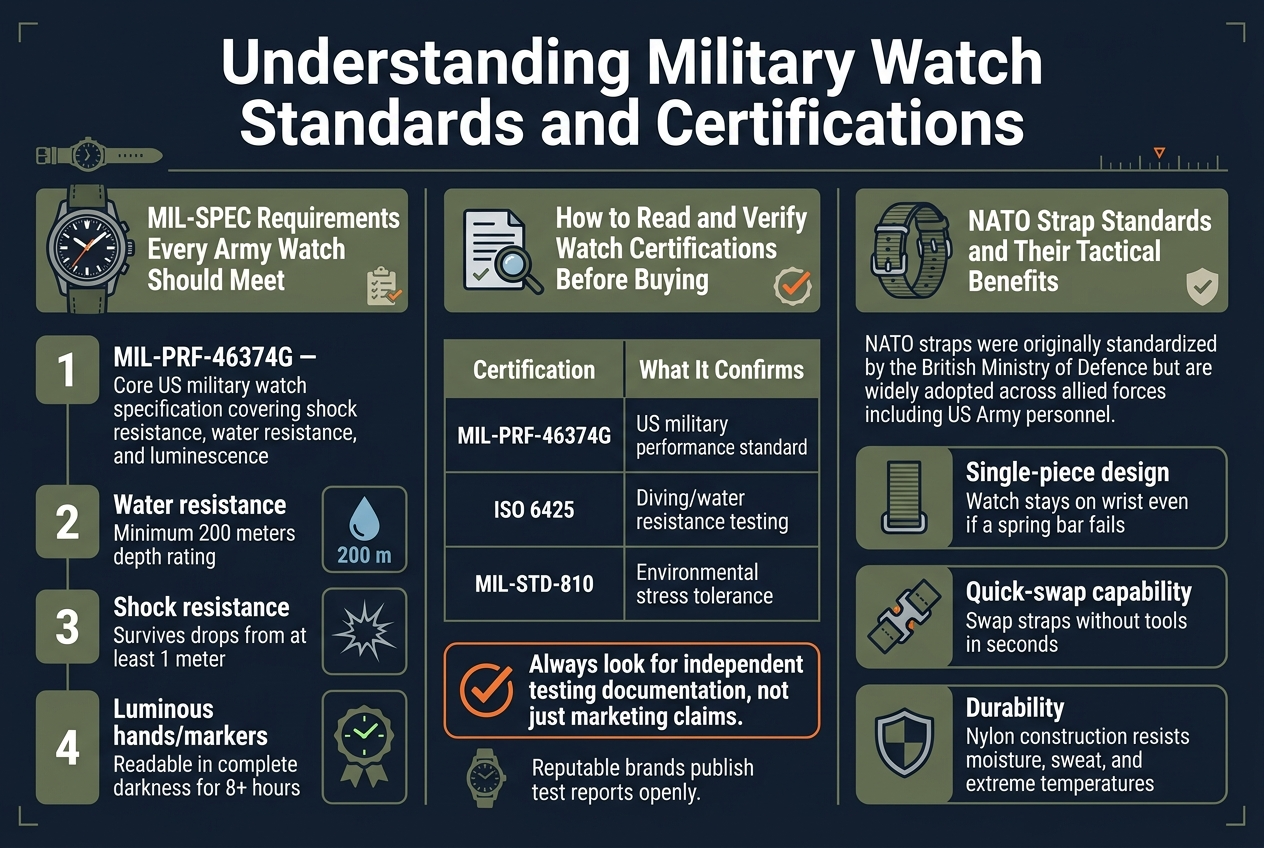
MIL-SPEC Requirements Every Army Watch Should Meet
Military-grade watches must pass rigorous MIL-SPEC standards to earn trust in the field. Key requirements include:
- MIL-PRF-46374G – The core US military watch specification covering shock resistance, water resistance, and luminescence
- Water resistance – Minimum 200 meters depth rating
- Shock resistance – Survives drops from at least 1 meter
- Luminous hands/markers – Must remain readable in complete darkness for 8+ hours
How to Read and Verify Watch Certifications Before Buying
Don’t just take a brand’s word for it. Check these when shopping:
| Certification | What It Confirms |
|---|---|
| MIL-PRF-46374G | US military performance standard |
| ISO 6425 | Diving/water resistance testing |
| MIL-STD-810 | Environmental stress tolerance |
Always look for independent testing documentation, not just marketing claims. Reputable brands publish test reports openly.
NATO Strap Standards and Their Tactical Benefits
NATO straps were originally standardized by the British Ministry of Defence but are widely adopted across allied forces including US Army personnel.
Key tactical advantages:
- Single-piece design – Watch stays on wrist even if a spring bar fails
- Quick-swap capability – Swap straps without tools in seconds
- Durability – Nylon construction resists moisture, sweat, and extreme temperatures
Best Military Watches by Use Case and Mission Type
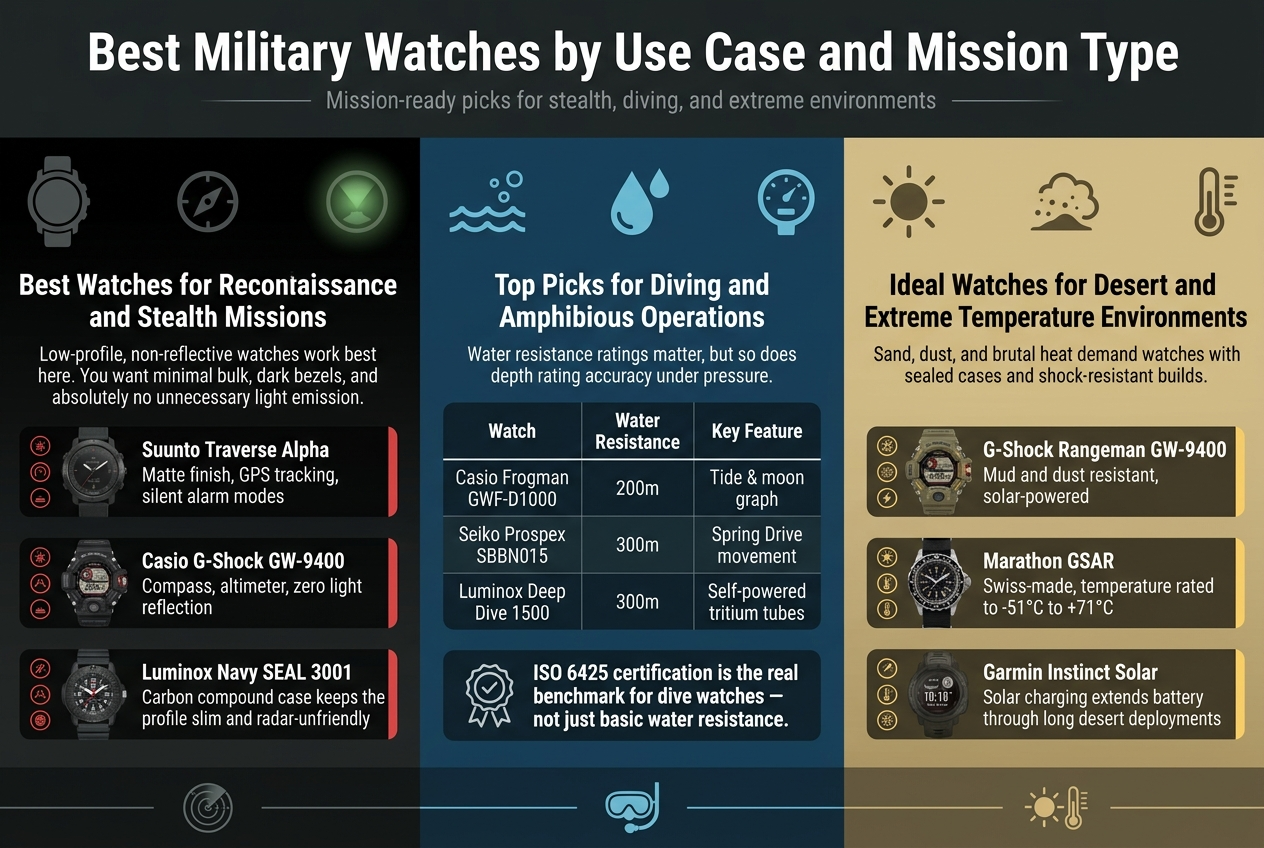
Best Watches for Reconnaissance and Stealth Missions
Low-profile, non-reflective watches work best here. You want minimal bulk, dark bezels, and absolutely no unnecessary light emission.
- Suunto Traverse Alpha – Matte finish, GPS tracking, silent alarm modes
- Casio G-Shock GW-9400 – Compass, altimeter, zero light reflection
- Luminox Navy SEAL 3001 – Carbon compound case keeps the profile slim and radar-unfriendly
Top Picks for Diving and Amphibious Operations
Water resistance ratings matter, but so does depth rating accuracy under pressure.
| Watch | Water Resistance | Key Feature |
|---|---|---|
| Casio Frogman GWF-D1000 | 200m | Tide & moon graph |
| Seiko Prospex SBBN015 | 300m | Spring Drive movement |
| Luminox Deep Dive 1500 | 300m | Self-powered tritium tubes |
ISO 6425 certification is the real benchmark for dive watches — not just basic water resistance.
Ideal Watches for Desert and Extreme Temperature Environments
Sand, dust, and brutal heat demand watches with sealed cases and shock-resistant builds.
- G-Shock Rangeman GW-9400 – Mud and dust resistant, solar-powered
- Marathon GSAR – Swiss-made, temperature rated to -51°C to +71°C
- Garmin Instinct Solar – Solar charging extends battery through long desert deployments
How to Maintain and Care for Your Military Watch
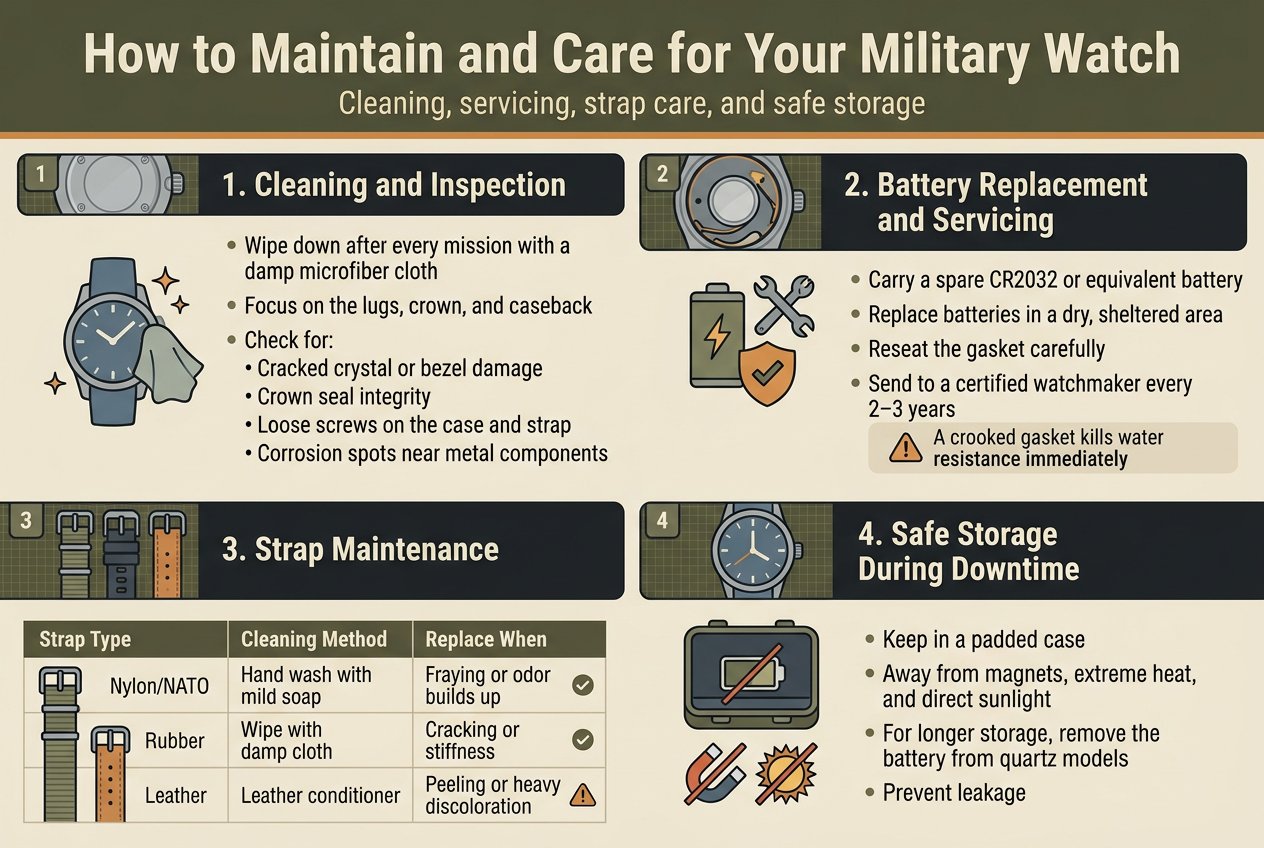
Cleaning and Inspection Routines to Extend Watch Life
Wipe down your watch after every mission using a damp microfiber cloth. Pay close attention to the lugs, crown, and caseback where dirt and sweat build up fast. Every few weeks, do a quick visual check for:
- Cracked crystal or bezel damage
- Crown seal integrity
- Loose screws on the case and strap
- Corrosion spots near metal components
Battery Replacement and Servicing Tips for Field Conditions
Carry a spare CR2032 or equivalent battery that matches your watch model. In the field, replace batteries in a dry, sheltered area to avoid moisture getting inside. Always reseat the gasket carefully — a crooked gasket kills water resistance immediately. Send your watch to a certified watchmaker for full servicing every 2–3 years.
Strap Maintenance and When to Replace for Optimal Performance
| Strap Type | Cleaning Method | Replace When |
|---|---|---|
| Nylon/NATO | Hand wash with mild soap | Fraying or odor builds up |
| Rubber | Wipe with damp cloth | Cracking or stiffness |
| Leather | Leather conditioner | Peeling or heavy discoloration |
Storing Your Watch Safely During Downtime or Deployment
Keep your watch in a padded case away from magnets, extreme heat, and direct sunlight. For longer storage, remove the battery from quartz models to prevent leakage.
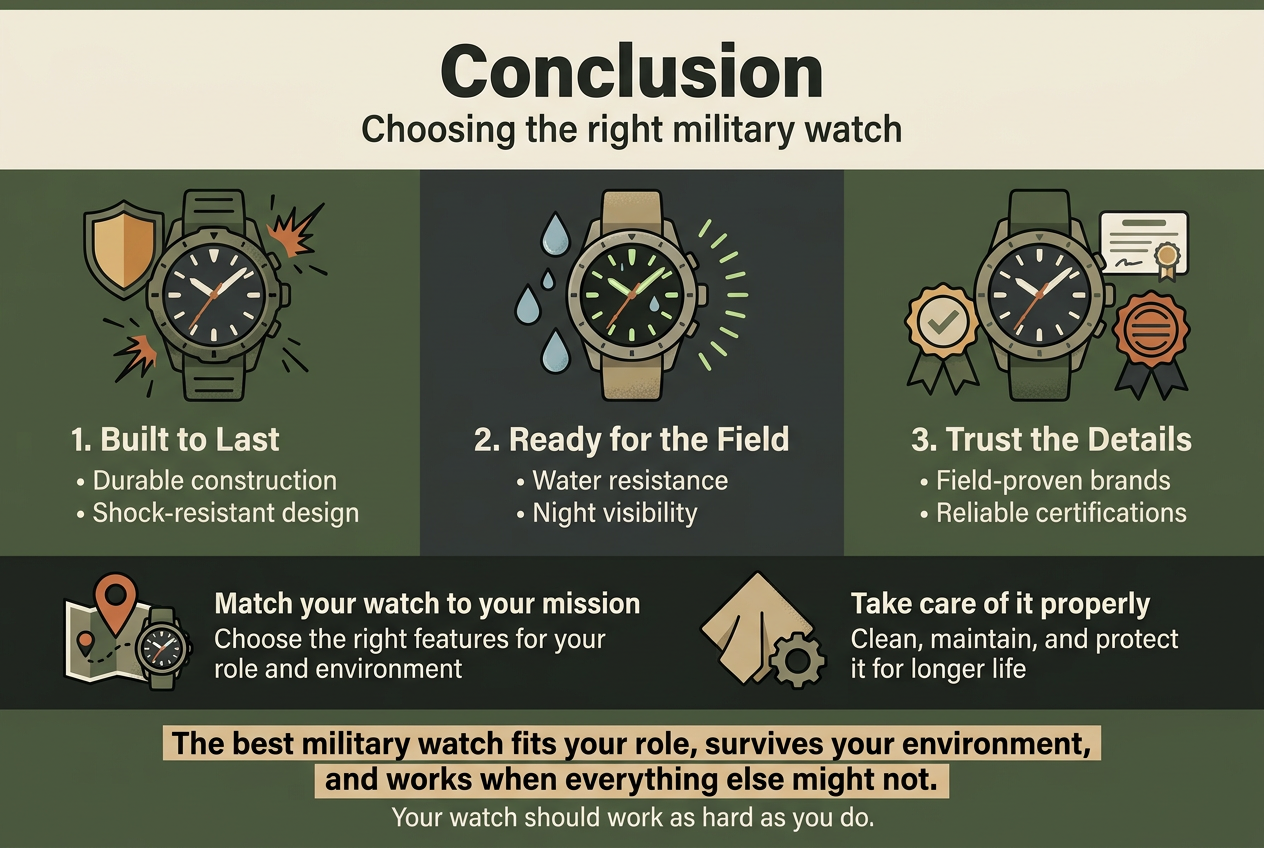
Choosing the right military watch as a US Army soldier is about way more than just telling time. From understanding key features like durability, water resistance, and night visibility, to knowing which brands and certifications actually hold up in the field, the right watch can genuinely make a difference when it counts. Matching your watch to your specific mission type and taking care of it properly only adds to its reliability and lifespan.
At the end of the day, the best military watch is the one that fits your role, survives your environment, and works when everything else might not. Take the time to research your options, prioritize the features that matter most for your missions, and invest in a timepiece that can keep up with the demands of service. Your watch should work as hard as you do.


